Last updated: August 20, 2026
Indoor rattan furniture works beautifully in some rooms and quietly falls apart in others, and the difference comes down to two things: how much moisture the room holds and how hard the piece gets used. A woven lounge chair in a dry living room lasts for decades. The same chair in a steamy three-season porch will not.
This is the overview page for the indoor rattan section. It covers the six rooms where people put rattan, the pieces that hold up in each, the five styles rattan slots into, and the mistakes that turn a good buy into a wobbly one.
This article contains affiliate links. If you buy through them, we may earn a commission at no extra cost to you. Learn more.
Quick Answer
What indoor rattan furniture works in which room?
- Living room: accent chairs, coffee tables and shelving, where use is frequent but rarely rough.
- Bedroom: headboards, nightstands and benches, adding texture without taking abuse.
- Dining room: side chairs on a solid wood frame, not chairs held up by weave alone.
- Sunroom: the trickiest room, because sun and humidity both attack natural cane.
- Entryway and office: benches, consoles and storage, seen more than sat on.
Is rattan furniture in style right now?
Yes, and it has been for long enough that it no longer reads as a trend. Rattan sits inside several established looks at once: it is warm, light in weight and in color, and it breaks up rooms full of flat upholstery. What has changed is the format. Full rattan suites are out, single statement pieces are in.
That matters when you shop. One rattan chair, one woven mirror and a cane-front dresser reads as considered. A bedroom where the bed, nightstands, bench and chair are all woven reads as a set bought in one click.
The five styles rattan slots into
Coastal pairs pale, bleached rattan with white or sand upholstery. Boho leans on darker, chunkier weaves and curved backs. Mid-century sets cane webbing into walnut or teak frames, the most structured of the five. Scandinavian keeps frames thin and finishes natural. Classic rattan is heavier and often painted, and suits older homes with deep trim.
Style dictates finish more than construction. A bleached coastal chair and a dark boho chair can be built the same way underneath, so judge the joinery separately from the look.
Indoor rattan room by room
Every room asks something different from a woven piece. Living rooms want daily comfort, dining rooms want a seat that survives being dragged and leaned back on, bedrooms want texture more than strength, and sunrooms want moisture tolerance first.
| Room | Rattan piece that works | What to check |
|---|---|---|
| Living room | Accent chair, coffee table, open shelving | Hardwood frame under the weave; seat cushion included or sized |
| Bedroom | Headboard, cane-front nightstand, end-of-bed bench | Cane panels glued into a groove, not stapled to the back |
| Dining room | Side chairs, sideboard with cane doors | Stretchers between the legs; seat rated for daily use |
| Sunroom | Resin wicker seating, or natural rattan away from glass | Humidity swings; direct sun on the weave |
| Entryway | Bench, console table, woven storage baskets | Wet shoes and umbrellas kept off the weave |
| Home office | Cane-back desk chair used occasionally, shelving | Not a task chair; no casters or gas lift on woven seats |
Living room, bedroom and dining room
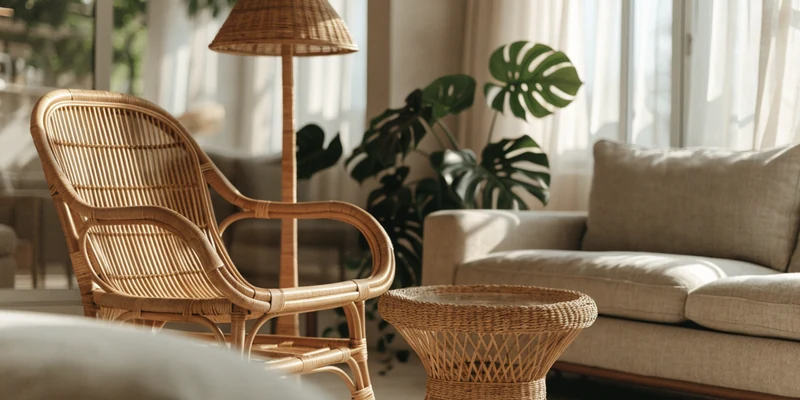
The living room is the easiest to get right, because a woven chair there is a second seat rather than the main sofa. Look for a hardwood frame doing the structural work and the weave doing the shaping, and check whether a cushion is included. Full breakdown in the guide to rattan chairs for the living room.
Bedrooms are forgiving because nothing there takes constant weight. A cane headboard, a woven nightstand and a bench give texture on three surfaces without stressing any of them; the thing to watch is dry winter air, covered in the rattan bedroom furniture guide. Dining rooms are the opposite: chairs get dragged and leaned back on, so a rattan dining set for indoor use needs stretchers and a seat built on a frame.
Sunroom, entryway and home office
Sunrooms swing between hot and humid and cold and dry, sometimes within a day, and that cycle is harder on natural rattan than steady conditions at either extreme. If the room is unconditioned, resin wicker is the honest answer; if it is climate controlled, natural rattan is fine away from the glass. The wicker sunroom furniture guide covers both.
Entryways and offices are low-risk, with one caveat each. In an entryway, keep dripping umbrellas and wet boots off the weave, because water sitting in it starts mildew. In an office, do not use a cane-seat chair as an eight-hour task chair.
Two pieces worth starting with
If you are adding rattan for the first time, start with a piece that carries the look without carrying the load. An accent chair and a cane-front nightstand give the most visual change for the least structural risk, and both are easy to move if the room does not work out.
🪑 Best first piece for a living room
An accent chair puts the weave at eye level where it reads as intentional, and it can move to a bedroom corner later. Check that the frame is hardwood and that a cushion is included. More in the rattan accent chair guide.

🛏️ Best low-risk piece for a bedroom
A cane-front nightstand adds texture on a surface nobody sits on, which removes the main failure mode. Check how the cane is attached: a panel set into a routed groove holds up better than webbing stapled behind an opening.

Where natural rattan struggles indoors
Natural rattan is an indoor material, and even indoors it has two enemies: sustained moisture and direct sun. Moisture softens the fibers and invites mildew in the tight spots of the weave. Ultraviolet light bleaches the surface until strands go brittle. Neither happens overnight, which is why people miss it until the damage is done.
Keep natural rattan out of unconditioned porches and bathrooms, off the wall behind a radiator, and out of the path of a strong south or west window, or filter that window with a sheer. If a room cannot meet those conditions, buy resin wicker for it instead.
Cane webbing and dry air
Cane webbing, the fine hexagonal mesh in chair backs and cabinet doors, moves with humidity. In a very dry winter house it contracts, and a panel stretched tight at installation can split or pull away at an edge. In a damp room it relaxes and sags. Neither means the piece was badly made; cane is a natural fiber doing what natural fibers do.
Keeping indoor humidity in a normal range rather than letting it swing helps, as does keeping a caned piece away from a heat source. A sagging panel can be re-tightened by a caning shop, but on an inexpensive chair the labor rarely justifies it.
Woven seats and daily use
A woven seat is not the same as a woven surface. Any seat carrying body weight needs a frame underneath: a hardwood seat rail, corner blocks, and legs joined with stretchers. When the weave is the only thing between you and the floor, the seat dishes, and it does not come back.
Find the underside photo. A wooden rail around the seat opening with corner blocks means the chair is built to be sat in; nothing but the back of the weave means occasional seating. The same applies to rattan dog beds, where a raised platform outlasts a shallow basket with a loose cushion in it.
Common Mistakes to Avoid
- Putting natural rattan in an unconditioned sunroom. The humidity cycle kills it, not one hot afternoon. Use resin wicker in rooms you do not heat and cool.
- Buying a woven seat for daily dining. Dining chairs get the roughest treatment in the house. Insist on a hardwood frame and stretchers.
- Filling a room with rattan. Two or three woven pieces read as design. Six read as a catalog page. Mix in wood, metal and upholstery.
- Ignoring the underside photo. The listing gallery almost always shows the frame somewhere, and that image tells you more than the description does.
- Cleaning with a soaking wet cloth. Water driven into a weave stays there. Vacuum with a brush attachment and wipe with a barely damp cloth.
Frequently Asked Questions
Is rattan furniture still in style? Yes. Rattan has moved from a full-room look to a per-piece accent, and it fits inside coastal, boho, mid-century, Scandinavian and classic interiors. Two or three woven pieces per room is safer than a matching suite.
Can natural rattan furniture go in a sunroom? Only if the sunroom is heated and cooled like the rest of the house, and only away from direct sun through the glass. In an unconditioned three-season room, resin wicker handles the humidity swings better.
What is the difference between indoor wicker and rattan? Rattan is the material, a climbing palm harvested as poles and cane. Wicker is the weaving technique, which can use rattan, reed, seagrass or resin. A chair can be both, while a resin chair is wicker but not rattan.
Why is my cane chair seat sagging? Cane absorbs and releases moisture, so it relaxes in humid conditions and tightens in dry ones, and repeated weight accelerates the stretch. A caning shop can re-tension a panel, though on a low-cost chair the labor rarely pays off.
Can rattan furniture handle daily use? It depends on the frame. A woven piece built on a hardwood frame with stretchers handles everyday sitting. A piece where the weave carries the load on its own is occasional seating, however good the weave looks.
The Bottom Line
Indoor rattan has a clear comfort zone. Give it a dry, climate controlled room out of direct sun, put the structural work on a hardwood frame instead of on the weave, and keep it to a few pieces per room. Do that and rattan lasts for decades. Ignore it and you get a sagging seat and a brittle, bleached weave.