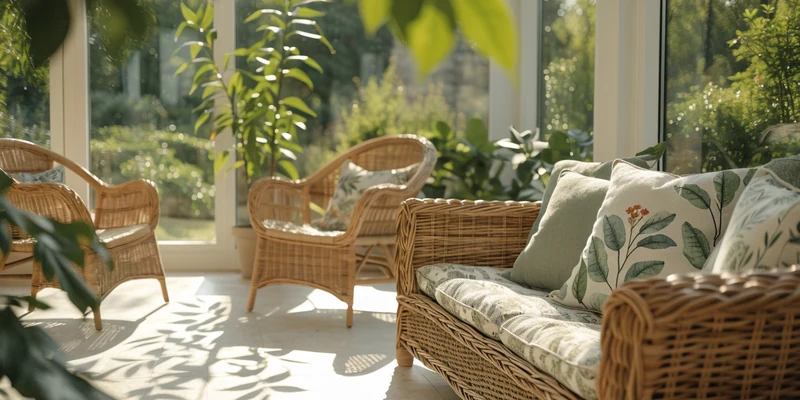
Last updated: August 20, 2026
A sunroom sits inside the house but behaves like the yard, and that is the whole problem with wicker furniture for a sunroom. The room takes far more ultraviolet light than any other space in the home, the temperature swings hard through the day, and if it is not conditioned it collects humidity too. Furniture that would last a decade in a living room can look tired there within two summers.
This guide covers the question that decides your shortlist, which materials hold their color behind glass, why cushion fabric outranks the frame, and how to fit real seating into a narrow room.
This article contains affiliate links. If you buy through them, we may earn a commission at no extra cost to you. Learn more.
Quick Answer
What kind of wicker furniture actually holds up in a sunroom?
- Resin or HDPE wicker on a powder coated aluminum frame is the safe default, because it is built for direct sun and damp air.
- Natural rattan works only in a sunroom that is heated and cooled year round, and only out of the direct sun path.
- Cushion fabric decides how the set looks in year three. Look for solution dyed acrylic or a fade resistant label.
- Pick loose, removable cushions over fixed upholstery, so the part that wears out is replaceable.
- Measure the walkway first. A standard patio set is often one seat too wide for a sunroom.
Why a Sunroom Is Not an Ordinary Room
A sunroom is a glass box facing the sun, so it collects light and heat the way a parked car does. Window glass filters some ultraviolet light, but plenty gets through, and the temperature range inside is wider than anywhere else in the house. Furniture there ages on an outdoor schedule, not an indoor one.
Two things follow. Color fades, and materials that depend on moisture content dry out. Fading hits fabric first, so a set keeps its shape while the cushions go pale.
What the sun does to natural rattan
Natural rattan and cane are plant fibers with a natural moisture level. Baked behind glass they lose it, and the fibers turn brittle and lighten unevenly. The first sign is usually a wrap lifting at the end of an arm, and that repair is fiddly and rarely invisible.
Is Your Sunroom Climate Controlled? That Decides Everything
Before comparing a single product, answer this: does the sunroom run on the same heating and cooling as the rest of the house, all year? If yes, you are shopping for indoor furniture with a sun problem. If no, you are shopping for outdoor furniture that happens to live under a roof. That answer removes most of the catalog for you.
A three season or enclosed porch, unheated in winter and unconditioned in summer, sits firmly in the outdoor category. Humidity there follows the weather outside: condensation on cold mornings, damp air in July, wood frames that swell and shrink.
The in between case
Many four season rooms are technically conditioned but still run warmer than the house in summer, because the glass wins. Treat those as outdoor rated too. Resin sets no longer look like patio furniture.
How Each Material Handles Direct Sun
The frame material sets the ceiling on how long a set lasts in that room. Resin and HDPE wicker are made to sit outside, so a sunroom is an easy assignment for them. Natural rattan and cane are indoor materials that a sunroom slowly pushes past their limits. Painted wicker depends entirely on what is underneath.
| Material | How it handles direct sun | Best for |
|---|---|---|
| Natural rattan | Dries out and lightens unevenly; wraps lift at the ends | Conditioned rooms, out of the direct sun path |
| Cane webbing | The most fragile option; brittle in dry heat, slack in damp air | Accent pieces only, in a stable room |
| Resin or PE wicker | Made for outdoor exposure; check the listing for UV stabilized | The default for most sunrooms and porches |
| HDPE wicker | The most sun tolerant weave in common use; shrugs off humidity | Hot, bright or unconditioned rooms |
| Painted wicker | Paint chalks, and the fiber underneath keeps aging | A refresh on a frame that is still sound |
Our explainer on resin versus natural wicker covers how each is made.
Cushions Decide How the Set Looks in Year Three
Cushions age faster than anything else in a sunroom, so fabric does more for the long term look of the room than the frame does. Solution dyed acrylic carries color through the fiber rather than on the surface, so it holds up under strong light far better than printed polyester.
If the listing does not name the fiber, look for the phrase fade resistant, then read reviews from buyers who mention a sunroom or a south facing patio.
Loose cushions beat fixed upholstery
Buy a set with removable cushions and covers you can take off. Cushions are consumable here, and swapping them every few years is a small job. Fixed upholstery turns that into a reupholstery quote, which on a mid range set is rarely worth paying.
Fitting Real Seating Into a Narrow Room
Sunrooms tend to be long and shallow, with a door swinging into the space and glass on three sides. The usual mistake is buying a conversation set sized for an open patio and then living around it. Measure the room, subtract a walking path of roughly three feet plus the door swing, and shop against what is left.
Two more measurements save trouble. Check seat depth, because deep outdoor seating pushes chairs further into the room than the footprint suggests. And low or open backs keep the sight lines to the glass.
Layouts that work in a shallow room
A loveseat against the solid wall with two chairs angled toward it usually beats a sectional. In a tight room, a chair with an ottoman and a side table gives you a reading corner without blocking the door, much like rattan seating in a living room.
What to Buy, by Situation
These are formats rather than specific models. Match the format to your room first, then compare listings on frame material, cushion fabric and size.
☀️ Best all round set for a bright room
A four piece resin wicker group on a powder coated aluminum frame: loveseat, two chairs, small table. Aluminum will not rust in damp air the way steel can, and the format suits most rooms without crowding them.

🔎 Best for a narrow or small sunroom
A three piece group, two chairs and a small table, instead of a full conversation set. It keeps the walkway clear and works against a single wall.

🛋️ Best loveseat
One substantial piece instead of several small ones. A wicker loveseat with its own cushions anchors the room and seats two. Check the assembled width against your longest solid wall.

🪑 Best chair and ottoman for reading
A single deep chair with a matching ottoman is the most space efficient way to make a sunroom genuinely comfortable, and the ottoman doubles as extra seating.

✨ Best replacement cushions
If the frames are sound and only the cushions have faded, buy cushions instead of a new set. Measure the old pads flat and shop by those dimensions.

Common Mistakes to Avoid
- Assuming indoors means protected. A sunroom delivers more ultraviolet light and a wider temperature range than any other room. Shop for it like a covered porch.
- Buying natural rattan for an unheated room. It looks wonderful for a season, then dries, lightens and loosens. Choose a synthetic weave instead and enjoy the set rather than nursing it.
- Ignoring the cushion fabric. The frame outlives the cushions by years, so a great frame with printed polyester cushions turns pale long before the weave shows age.
- Skipping the tape measure. Outdoor sets are built for open patios. Check assembled width and seat depth against the real room, door swing included.
- Choosing a steel frame for a damp room. Powder coating protects steel until it chips, and a damp sunroom finds the chips. Aluminum sidesteps it.
Frequently Asked Questions
Can you put natural rattan furniture in a sunroom? Only if the room is heated and cooled all year, and even then it belongs away from the direct sun path. Natural rattan loses moisture in dry heat and takes it back up in humid air, and those cycles leave the fibers brittle.
Is resin wicker appropriate for indoor use? Yes. Modern resin and HDPE weaves come in the same colors and textures as natural wicker, and most sets read as indoor furniture once they have proper cushions. They simply tolerate sun and humidity better.
What furniture works in an enclosed porch that is not heated or cooled? Treat the room as outdoors. Synthetic wicker on an aluminum frame, cushions in an outdoor fabric, and no solid wood pieces that swell and shrink through the seasons.
Do sunroom cushions need to be outdoor fabric? It is the safer choice in any room with strong light. Outdoor fabrics, particularly solution dyed acrylic, keep their color under ultraviolet exposure and handle damp air well. Indoor upholstery fades noticeably faster in the same spot.
How do I keep sunroom furniture from fading? Start with materials that resist fading, then cut the exposure. Solar shades or a light filtering blind on the brightest side make a real difference, and rotating cushions occasionally keeps the fading even.
What size seating fits a narrow sunroom? Measure the room, subtract about three feet for a walking path plus the door swing, and shop against the remainder. In a shallow room a loveseat with two angled chairs fits better than a sectional.
The Bottom Line
Answer the climate question first. If the sunroom is not conditioned all year, buy resin or HDPE wicker on an aluminum frame and drop natural rattan from the shortlist. If it is conditioned, natural rattan becomes possible, but keep it out of the direct sun path. Either way, spend your attention on the cushions and choose loose covers.