Last updated: August 20, 2026
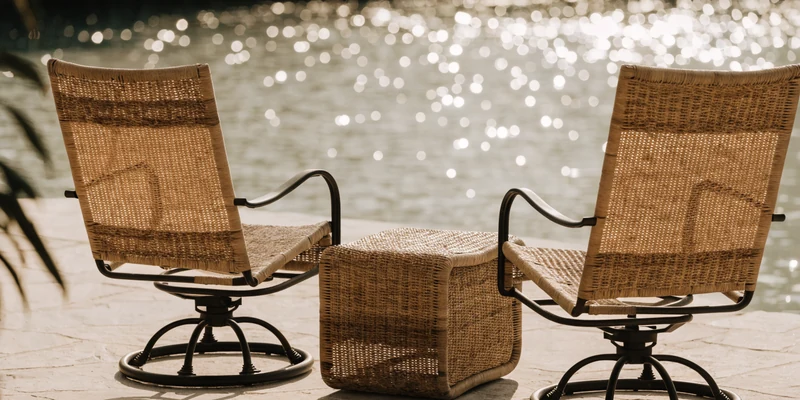
Wicker swivel rocker patio chairs are the most popular resin wicker seat on an American patio, and the one type where hardware you cannot see decides whether you are still happy in three summers. The weave gets the attention in the photos. The base underneath it is the part that fails.
This guide separates the three motions that get sold under similar names, explains why a broken base usually ends the chair, and lists what to read off the listing before you order. Hardware changes between model years, so treat this as a checklist to run against the current product page rather than a spec sheet.
This article contains affiliate links. If you buy through them, we may earn a commission at no extra cost to you. Learn more.
Quick Answer
What should you check on wicker swivel rocker patio chairs?
- Decide on the motion first. Swivel only, swivel rocker on a spring base, and glider are three different products.
- You are buying the base. Replacement bases are almost never sold separately, so a failed one retires the chair.
- On uneven pavers a wide cross base sits steadier than a narrow ring base, which finds every low spot.
- Powder coated aluminum will not rust at the welds. Steel can, and the weld is where the coating runs thinnest.
- Compare the listed seat depth against cushion thickness. A thick cushion turns a deep seat into a shallow one.
Swivel, Swivel Rocker or Glider
Three motions share almost the same product names. A swivel chair rotates on a bearing and does nothing else. A swivel rocker adds a spring base below the bearing, so it turns and also tips back against spring tension. A glider swings forward and back on parallel arms without rotating. A fourth option, the stationary chair, gets photographed alongside all of them.
Photographs will not tell them apart, because all three look identical from the front. The giveaway is in the listing text and the underside photo, if there is one.
| Motion type | How it feels | Best surface for it | Watch out for |
|---|---|---|---|
| Swivel only | Turns freely, sits still otherwise | Decking, gravel, uneven pavers | The bearing is the entire product; a rough one never smooths out |
| Swivel rocker | Turns and tips back against springs | Flat concrete or a solid, level deck | Springs are the first part to squeak and the first to fail |
| Glider | Swings in a straight line, no rotation | Covered porch or a level slab | Linkage pins loosen and the arms start to knock |
Most people who say they want a rocker want the swivel rocker, because the tilt is gentle and self centering rather than a full arc. If you want a true rocking motion, that is a different chair; our guide to the wicker rocking chair covers those.
What to Buy, by Situation
The decision comes down to four questions: how many seats you need, whether cushions are included, whether you need bar height rather than lounge height, and whether you are replacing worn cushions on chairs you own.
🪑 The standard pair
Two matching swivel rockers is the format most patios end up with, flanking a small side table. Check that the listing states the base type and that both chairs ship with the same hardware.

🧶 Cushions included
Buying chair and cushion together avoids a sizing mismatch later. Confirm the cover fabric is described as outdoor rated and that the covers unzip.

🍸 Bar height
Swivel stools work at an outdoor bar or high top table where lounge chairs sit far too low. A footrest ring matters more here than the swivel does.

🛋️ Cushions only
If the frames and bases are sound and the cushions have gone flat, replace the cushions. Measure the seat platform rather than the old cushion, which has compressed.

The Base Is What You Are Really Buying
Everything above the base is durable. Resin wicker over a metal frame handles sun and rain for years, and cushions are a consumable you expect to replace. The swivel base is the one component that is both mechanical and effectively unrepairable, which is why it deserves most of your attention.
Replacement bases are rarely available. Manufacturers treat the base as part of the chair rather than a spare, and by the time yours fails the model is usually discontinued. A seized bearing or a cracked spring housing tends to mean a new chair.
Cross Base Versus Ring Base
A cross base has four legs spreading from the center column, so it rests on four widely spaced feet. A ring base is a single circular foot. On a poured slab both are fine. On brick or stone pavers, which are never perfectly flat, the ring base rocks, because the whole ring has to sit level at once.
Decking causes the same trouble, since boards run one way and a base can bridge a gap. Listings rarely name the base type, but a side view photo shows it. Check for leveling feet while you are looking.
The Bearing, and Whether It Can Be Greased
Most swivel plates are a ball bearing race between two stamped steel plates. A few listings mention a grease fitting or a serviceable bearing. If yours has one, a shot of marine grease once a season is the best thing you can do for the chair.
Sealed units cannot be serviced. They last until grit and rain get past the seal, then turn stiff and gritty. A cover, or tipping the chairs forward against a wall before a storm, keeps water out of the mechanism.
Frames, Welds and Rust
Under the weave there is a metal skeleton, and it is either aluminum or steel. Aluminum does not rust and weighs less. Steel is stronger for the same tube diameter and heavier, which some people prefer on a windy patio, but it will corrode wherever water reaches bare metal.
Powder coating protects both, and it is the coating rather than the metal you are really assessing. Coating goes on thinnest at the welds and at sharp bends, so those are the first places rust shows on a steel frame.
What the Listing Will and Will Not Tell You
Listings state the frame material often enough and the powder coat almost never. If the description only says metal frame, assume steel. The weave itself is the least of your worries, since resin strand over metal handles UV and rain without drama. Our overview of wicker patio chairs covers the weave grades.
Seat Depth, Cushions and Buying in Pairs
Seat depth on a listing is measured on the bare frame, before the cushion goes in. Add a thick cushion and the usable depth shrinks, sometimes enough that shorter sitters find the front edge cutting behind the knee. Read seat depth and cushion thickness together rather than either on its own.
Cushion thickness also changes the effective seat height, which matters if the chairs get pulled up to a table or a fire pit. A chair that measures right on paper can sit too tall once a deep cushion drops in.
Sets of Two Versus Four
Sets of two are the common format and the easiest to store over winter. Sets of four commit you to one model, so if you think you will expand later, buy the four now; matching a discontinued weave color a year on is a losing game. Check the same collection for a matching outdoor wicker couch while you are there.
Common Mistakes to Avoid
- Assuming every swivel chair also rocks. Many listings use the word swivel alone, and the chair turns without tipping.
- Ignoring the base type on a paver patio. A ring base on uneven stone rocks for the life of the chair.
- Buying cushions to the old cushion size. Compressed foam measures smaller than it did new. Measure the seat platform.
- Leaving the mechanism uncovered all winter. Water sitting in a sealed bearing is what turns a smooth swivel gritty.
- Counting on replacement parts. Bases are rarely stocked as spares, so buy the chair you would keep whole.
Frequently Asked Questions
What is the difference between a swivel rocker and a glider? A swivel rocker rotates on a bearing and tips back against springs in the base. A glider does not rotate; it swings on parallel arms. Gliders feel smoother, swivel rockers are more versatile because you can turn to face someone.
Do wicker swivel rocker patio chairs work on a deck? Yes, provided the base stays stable across the boards. A wide cross base is the safer choice, because it keeps several feet in contact even when one bridges a gap.
Can you replace a swivel base if it fails? Usually not. Manufacturers treat the base as part of the chair, and the model is often discontinued by the time it wears out. Some owners fit a generic swivel plate, but bolt patterns rarely line up.
Is an aluminum frame better than steel outdoors? Aluminum will not rust, which is the main argument for it. Steel is heavier and stays put in wind, but any break in the powder coating, especially at a weld, gives corrosion a starting point.
Can these chairs stay outside all winter? The frame and weave generally can. The mechanism and cushions are the vulnerable parts, so store cushions indoors and cover the chairs. Check what the manufacturer states for your model.
The Bottom Line
Pick the motion first, then buy the base. A swivel rocker on a wide cross base suits most patios, a swivel only model is the safer bet on uneven pavers, and a glider is for people who want smoothness over versatility. Read the frame material, use the underside photo to identify the base, and compare seat depth against cushion thickness. Since replacement bases are rarely available, the mechanism is the part worth paying for.