Last updated: August 20, 2026
Rattan dining chairs indoors take more punishment than any other woven furniture in the house. They get pulled out and pushed back several times a day, tipped onto their back legs, sat in by guests who do not treat them gently, and showered with crumbs and spilled drinks. That is a very different job from an accent chair used on Sunday afternoons.
This guide starts where the failures start, at the seat, then covers whether a chair will fit under the table you already own, whether to buy a matched set or mix, and how the weave behaves once real meals happen on it. Confirm dimensions and materials on the listing before ordering.
This article contains affiliate links. If you buy through them, we may earn a commission at no extra cost to you. Learn more.
Quick Answer
Which rattan dining chairs hold up to daily use?
- Seat construction decides everything. An all woven seat with nothing solid underneath sags first.
- Cane webbing stretched into a hardwood frame lasts longer, though it dries out in very dry indoor air.
- A solid wood or upholstered seat with a rattan back gives you the look without the sagging, and it is the safest choice for a family table.
- Measure the gap to your table apron before buying, and check that any armrests clear it.
- A wood or stone table with rattan chairs usually reads better than a fully matched rattan set.
The Seat Is Where Rattan Dining Chairs Fail
Nearly every complaint about indoor rattan dining chairs traces back to one thing, an unsupported woven seat. Weaving carries weight through tension, and tension slackens with daily use. A chair that puts the weave on the back and something solid under the seat still looks woven, and it is still usable years later.
This matters more at a dining table than anywhere else because of how people sit there. Diners drop into the chair, shift sideways to reach across the table, and lean back on two legs. Each of those loads the seat unevenly, which is what loosens a woven panel.
How to Read a Listing for This
Photographs of the underside tell you more than the description does. Look for a frame rail under the seat, or a panel with the weave applied over it. If every photo shows the chair from above, treat that as an answer in itself.
| Seat construction | How it handles daily use | Best for |
|---|---|---|
| All woven seat | Slackens over time under repeated uneven loading; strands can lift and catch on clothing | Occasional seating, a desk chair, a spare chair pulled out for guests |
| Cane webbing in a wood frame | Holds tension well when properly seated in the groove; can dry and loosen in very dry air | Adult households and dining rooms with normal indoor humidity |
| Solid wood seat, rattan back | The seat does not change at all; only the back needs attention | Family tables and daily meals, the most durable everyday option |
| Upholstered seat, rattan back | Very comfortable for long meals, but the fabric is what stains and wears | Dining rooms used for lingering rather than quick meals |
None of these is wrong, they simply fail in different places. Pick the construction that fails somewhere you can live with, then choose the style you like within it.
Will They Actually Fit Under Your Table?
The most common return reason for dining chairs has nothing to do with quality. The chair arrives, it looks right, and then it will not slide under the table. Two measurements prevent this, the vertical gap between the tabletop and the seat, and the width across the armrests if the chair has them.
Measure from the floor to the underside of your table apron rather than to the tabletop, because the apron is the part the chair actually hits. Then compare that against the seat height and arm height the seller lists.
Armrests and the Pedestal Problem
Rattan armchairs at the head of a table look excellent and carry the biggest fit risk. Arms often sit higher than a standard apron, so the chair parks a hand’s width out from the table permanently. If you want arms, measure first and accept that they may only work at the ends.
Round pedestal tables add their own catch. The base spreads outward at floor level, so a chair with splayed legs or a wide foot rail meets the pedestal before the seat reaches the table. Straight legs with a narrow footprint avoid this entirely.
A Matched Set, or Chairs That Just Get Along?
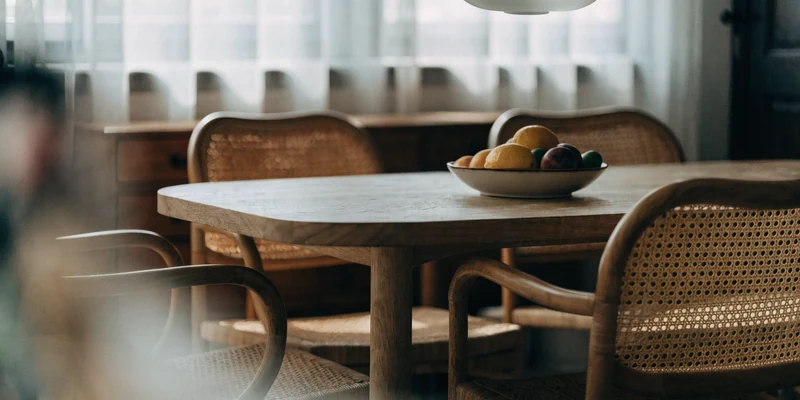
A fully matched rattan dining set, table included, is the least flexible thing in this category. It commits the room to one material and one era, and if a chair breaks you are hunting a discontinued match. A wood or stone table with rattan chairs is easier to live with and easier to repair.
The practical reason matters as much as the aesthetic one. Rattan and cane chairs are sold in twos and fours, and stock rotates fast, so buying four now and adding two next year rarely works out. If you expect to seat more people later, buy the larger count immediately.
When a Set Does Make Sense
Buy the set when the chairs are the quiet element rather than the statement, for instance in a sunroom or breakfast nook where the room already leans natural. Our guide to wicker furniture for a sunroom covers what changes when strong daylight is part of the room.
What to Look for, by Situation
These are shapes worth shortlisting rather than named models, because availability in woven furniture rotates constantly. Match the situation to the construction described above, then check what the seller publishes about frame material and seat build.
🍽️ Best all rounder: a set of four with a supported seat
Buying four at once solves the matching problem, and a solid panel under the weave is the version that survives a family.

🪑 Best classic look: cane back with a closed seat
The cane back puts the woven texture at eye level, where it is actually seen, while the seat stays solid. This combination ages best in a room used every day.

✨ Best for the ends of the table: a rattan armchair
Two armchairs at the head and foot with side chairs between them makes a mixed set look intentional. Measure the apron before committing to arms.

🌿 Best for a small kitchen: a narrow or stackable chair
In a tight eating area, the chair you can lift with one hand and stack against a wall earns its place. Woven side chairs weigh very little.

🧺 Best comfort upgrade: tie on seat cushions
A thin cushion keeps people at the table after the plates are cleared, and it takes the crumbs instead of the weave. Ties matter more than thickness.

Crumbs, Spills and the Weekly Clean
Woven dining chairs collect crumbs in the gaps and hold them there. The fix is a vacuum with a soft brush attachment run over the seat and around the frame joints once a week, which prevents the gritty feel that makes people quietly stop using a chair.
Spills need a different response. Natural rattan and cane should be blotted immediately and never soaked, because water sitting in a weave swells the fibers and leaves them loose once dry. Wipe with a barely damp cloth, then dry the area.
Dry Air Is the Quiet Enemy
Cane webbing loses tension when indoor air stays very dry through a heating season, and a chair that sounds crackly under you is telling you something. Ordinary comfortable humidity does more for these chairs than any product. For deeper routines, see how to clean wicker furniture.
Common Mistakes to Avoid
- Buying on the photo instead of the seat build. Two chairs can look identical from above and behave differently after a year.
- Ordering armchairs without measuring the apron. Arms that do not clear the table annoy you at every meal.
- Buying four now and adding two later. Matching a discontinued woven chair is close to impossible.
- Scrubbing a spill with a wet cloth. Water driven into a weave is what loosens it; blot, wipe lightly, then dry.
- Choosing an all woven seat for a household with children. It sags first, and it snags clothing as it does.
Frequently Asked Questions
Are rattan dining chairs durable enough for everyday use? It depends entirely on the seat. A rattan or cane back over a solid wood or upholstered seat handles daily meals well. A seat made only of weaving with no frame beneath it is the version that slackens, and it is better suited to occasional seating.
What is the difference between cane and rattan on a dining chair? Rattan is the palm material the frame is made from, and cane is the outer skin of that same plant, cut into strips and woven into the sheet webbing set into chair backs. A chair can be rattan framed and cane backed at once.
Can rattan dining chairs be repaired if the seat sags? Cane webbing set into a groove can be replaced by a caning specialist, and press cane sheet is sold for that job. A fully woven seat wrapped around a frame is much harder to restore and often not worth the labor.
Do rattan dining chairs need cushions? Not structurally, but most people add them. A thin tie on cushion makes long meals more comfortable and keeps crumbs out of the weave. Look for ties at the back corners so the cushion stays put.
Should the dining table match the rattan chairs? Usually not. A wood or stone table with rattan chairs is easier to live with and easier to replace one piece of. Fully matched groups work best in sunrooms and breakfast nooks.
How do you clean crumbs out of woven dining chairs? Use a vacuum with a soft brush attachment weekly, working across the seat and into the joints where the weave meets the frame. A dry paintbrush loosens anything stuck deeper before you vacuum.
The Bottom Line
Choose the seat construction before the style. A rattan or cane back over a solid or upholstered seat survives daily meals; an unsupported woven seat belongs on a chair used occasionally. Measure the table apron before buying anything with arms, buy the full count in one go, and pair the chairs with a table in a different material.