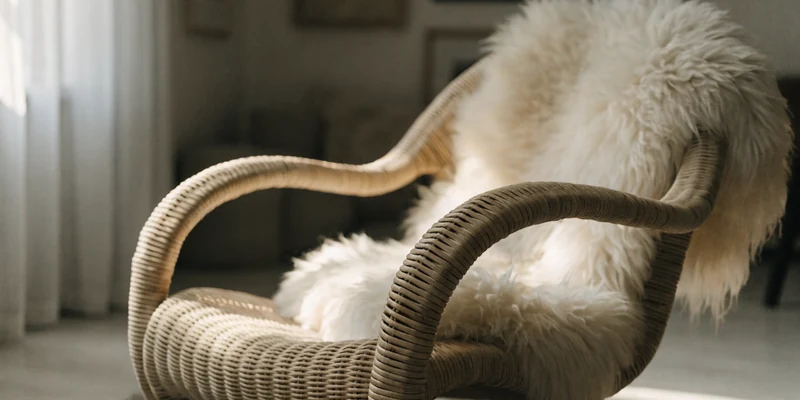
Last updated: August 20, 2026
A rattan accent chair is the easiest way to bring woven material into a room without committing to a set, and it is the product where quality varies most. Two chairs can look identical in a photo while one sits on a solid rattan pole frame and the other is a metal tube in a rattan-look skin.
This guide covers the product itself: the frame, the joints, the seat support and the shapes. For placement and pairing, see the companion piece on rattan chairs in the living room.
This article contains affiliate links. If you buy through them, we may earn a commission at no extra cost to you. Learn more.
Quick Answer
How do you spot a rattan accent chair that lasts?
- Look for solid rattan pole, bent rattan or hardwood, not a metal tube under a decorative weave.
- Joints should be bound with rattan peel, not held by staples alone.
- The seat needs webbing, springs or a panel beneath it. Woven material alone will sag.
- Check the listing for assembled size, weight capacity and seat depth.
- Keep cane out of direct sun and away from radiators, since dry heat makes it brittle.
What a rattan accent chair actually is
A rattan accent chair is a single occasional chair built from rattan, the stem of a climbing palm. The thick core becomes pole for frames, the outer skin is stripped into peel for binding, and split core is woven into cane webbing for backs and seats. A chair may use one of those or all three.
The three parts fail differently. Pole is structural and outlives the rest if the joints hold, peel binding loosens slowly and can be rewrapped, and cane webbing is thinnest, so it stretches or splits first. Rattan is the plant, cane the woven sheet, and wicker the technique rather than a material.
Frame types, and what each one means
The frame decides how long the chair lasts, so identify it first. Photos give it away if you know where to look: at the leg ends, where the arm meets the back, and anywhere two round members cross. The table covers the five constructions you will meet on a product page.
| Frame type | How to recognize it | What it means for durability |
|---|---|---|
| Solid rattan pole | Thick round members, visible growth nodes, ends capped or bound | Sturdiest option. Rigid and repairable; joints can be rewrapped |
| Bent rattan | Curved loops with no joint in the bend, flattened inside the curve | Strong and light. Bending removes joints, so less can come apart |
| Metal frame, woven seat | Slim uniform legs, powder-coated, weave stops where metal starts | Rigid, but the weave is decorative. The join to the metal wears first |
| Wood frame, cane webbing | Square or tapered legs, cane sheet set into a groove with spline | Long-lived frame, replaceable webbing. The cane ages, the wood does not |
| All-woven, no inner frame | No hard members visible, the shape flexes when lifted | Weakest build. The seat drops over time and cannot be tightened back |
How the joints are held together
Joints are where a woven chair gives up. On a well-made frame two members meet, get glued or pegged, and are wrapped in rattan peel that pulls the joint tight as it dries. On a cheaper chair the same joint is stapled through the wrap, so the staple does the work and the wrapping is cosmetic.
Close-up images usually tell you which it is. Even turns with the tail tucked under itself mean a bound joint; a dimple or a thin metal line showing through means staples. While you are zoomed in, check that leg ends are capped and look for a stretcher low between the legs, since a chair without lower bracing leans on its top joints alone.
Check what is underneath the seat
A seat needs a structure, not just a surface. The good versions use elastic webbing across a frame, a sprung platform, or a solid panel with foam on top. All three keep their shape. What does not keep its shape is a woven panel carrying body weight with nothing beneath it.
That is the honest limitation of the category. A purely woven seat looks beautiful on day one and gradually forms a bowl. If the listing shows the underside, that one photo tells you more than the whole description; if it does not, the assembly manual often will.
Shapes, and who each one suits
Shape decides comfort more than material does. Five shapes cover almost the entire market and they sit very differently: a barrel wraps you, a cane-back holds you upright, a hoop leans you back, a spindle keeps you formal, and a low lounge puts your hips below your knees. Choose the posture first.
Barrel, cane-back and spindle
A barrel or tub has a curved back that wraps into the arms. It looks finished from every angle, so it suits a corner, though it takes more floor area than its seat size suggests. A cane-back pairs a wooden frame with a webbed panel and is the most upright of the group. A spindle back uses vertical rods and stays visually light.
Hoop and low lounge
A hoop or moon chair is a full circle with the seat slung inside it: relaxed, distinctive and bulky, so measure first. A low lounge sits deep and reclined, comfortable for reading but harder to get out of.
Our picks by situation
These are the five configurations worth shortlisting, described by what they are rather than by brand. Match one to your room and your posture, then run the frame and seat checks on the listing.
🪑 Best overall
A rattan frame with a supported seat and a loose cushion. It suits the most rooms, and the cushion can be replaced later without touching the frame.

🌿 Best cane-back
A hardwood frame with a cane webbing panel in the back. The most upright shape, and the easiest to slot next to a desk between uses.

🛋️ Best barrel shape
A round wrapped back that closes into the arms. Choose this when the chair stands alone in a corner and is seen from behind.

✨ Best for long sitting
A deeper seat with a thick pad rather than a thin token cushion. If someone will read here, cushion depth beats weave pattern.

🔎 Best for a small room
A narrow rattan side chair with a light open frame. It gives you the texture in a hallway or bedroom corner without the floor space a barrel takes.
Cushions, listings and where the chair can stand
Most rattan accent chairs ship with a cushion, and most of those are thinner than the photo suggests. Foam density is rarely published, so judge by stated thickness and by whether the cover unzips. A pad you can wash beats a prettier one sewn shut, and a poor pad is replaceable anyway.
On the listing, look for assembled size, seat depth, a stated weight capacity and a clear assembly step. When those are missing you are buying on photographs alone, which is how all-woven chairs get sold. The same eye for published detail applies across the material, as our guide to spotting quality wicker covers.
Sun and dry heat
Natural rattan and cane are indoor materials, and dry heat is their real enemy. Direct sun through a south-facing window fades the finish and makes cane brittle; a radiator does the same faster. Keep the chair out of both, and wipe cane webbing occasionally with a barely damp cloth.
Common Mistakes to Avoid
- Buying the shape from the photo. A styled image flattens depth. Check seat depth and seat height in the specs instead.
- Assuming any weave is structural. On many chairs the weave is a surface over metal. Not a fault, but it changes what you can expect.
- Ignoring the underside. If no photo shows what carries the seat, assume nothing does.
- Putting a cane-back chair in full sun. Bleaching and brittleness are permanent. Move it before the panel splits.
- Skipping the cushion measurements. A replacement pad is easy to find only if you know the seat width and depth.
Frequently Asked Questions
Is a rattan accent chair strong enough for daily use? A solid rattan pole or hardwood frame with a supported seat handles daily use without trouble. A chair whose seat is woven material alone is better kept occasional, since the weave stretches under repeated weight. Check the capacity the manufacturer lists.
What is the difference between a cane accent chair and a rattan one? Rattan is the palm stem used for the frame; cane is the split outer skin woven into a flat sheet. A cane accent chair usually means a wooden or rattan frame with a cane webbing panel, so most cane chairs contain rattan but not the reverse.
Do rattan accent chairs sag over time? Woven seats without inner support gradually form a dip, because the weave stretches and nothing underneath resists it. Seats built over webbing, springs or a panel keep their shape, and the difference is visible in any photo of the underside.
Can a rattan accent chair go on a covered porch? Natural rattan is an indoor material and will swell, spot and eventually delaminate in humid air. For a porch or sunroom, look for a resin weave over a rust-treated frame instead.
Can a broken cane panel be repaired? A webbing panel set into a groove can be cut out and replaced with a fresh sheet and new spline, which is a standard job. A panel woven strand by strand into the frame is rarely worth the work on an inexpensive chair.
The Bottom Line
Judge a rattan accent chair by its frame and its seat support, not by its weave pattern. Solid pole, bent rattan and hardwood with cane webbing all last; a metal frame under a decorative weave is fine once you know that is what you are buying; an all-woven chair will sag. Pick the shape that matches how you want to sit, confirm seat depth, and treat the cushion as the part you will replace.