Last updated: August 20, 2026
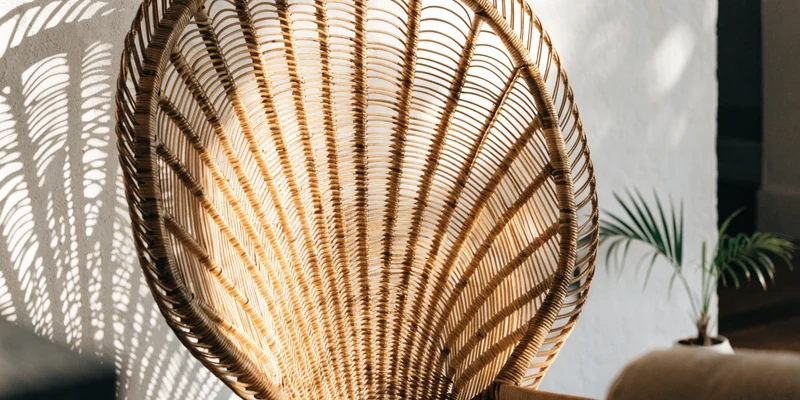
A rattan peacock chair is one of the few pieces of furniture people buy for its silhouette first and its seat second. The tall woven fan back turns a corner into something deliberate, which is why it keeps showing up in living rooms, sunrooms and nurseries that stay plain otherwise.
That popularity creates a messy market. You can buy one secondhand or new from an importer, and the two routes carry very different risks. This guide covers what separates a solid frame from a tired one, what to check before you commit, and how to be sure it fits through your door.
This article contains affiliate links. If you buy through them, we may earn a commission at no extra cost to you. Learn more.
Quick Answer
Should you buy a peacock chair vintage or new?
- Buy new if you want a frame you can sit in without worrying about it.
- Buy vintage only if you can inspect the weave in person.
- Skip any secondhand chair with broken strands in the fan; that repair is specialist work.
- Measure the back height against your door opening and ceiling first.
- Plan on a cushion; almost nobody finds the bare seat comfortable for long.
What makes a peacock chair different from an ordinary rattan chair?
The peacock chair is defined by a tall fan of woven rattan rising above the sitter’s head, carried on a narrow waist and a wide round base. Ordinary rattan chairs spread their load across four legs. This one channels everything through one column, which is why frame quality matters more here than in any other woven seat.
It also explains the price of failure. A loose leg on a dining chair is an evening of work with glue and a clamp; a sagging fan back means the vertical poles have moved, and reshaping the weave without new material is rarely realistic.
Where it usually ends up
Most owners treat it as a statement piece rather than daily seating: a bare corner, the side of a wide window, a backdrop for photos. If you want a chair you sink into every evening, a rattan accent chair is the more sensible buy.
Vintage or new: which route actually makes sense?
New is the safer default. Vintage examples can be beautiful, but many are decades old, and rattan that has spent years in dry indoor heat becomes brittle. A weave that looks charmingly aged in a photo can crack the first time somebody leans back, and rebuilding a large woven fan costs more than a new chair.
Vintage still wins when you can put your hands on the chair before paying, or when you want the patina rather than a uniform factory finish. Then you are buying a known object, not a blurry photo.
How the four common routes compare
| Buying route | What you usually get | What to check first |
|---|---|---|
| Vintage marketplace | Older natural rattan, sold as is, often local pickup only | Close photos of the fan edges and base; ask whether strands are broken or lifting |
| Thrift or estate sale | Lowest outlay, unpredictable condition, sometimes painted over | Flex the base and listen for cracking; look for insect holes and soft poles |
| New imported rattan | Consistent natural or stained finish, flat packed or assembled | Pole thickness, how the fan is fixed, and the seller’s damage policy |
| New metal-frame lookalike | Steel or aluminum core wrapped or woven to imitate the shape | Whether the weave is natural rattan or resin, and how the wrap is finished |
What to check before you buy a new one
Three things separate a chair that lasts from one that creaks within a season: the thickness of the rattan poles, whether the fan is bound or glued, and whether the maker publishes a weight limit at all. All three are visible or stated on a good listing, and a seller who dodges them tells you something.
Frame poles and the join at the waist
Look at the vertical poles where the seat meets the base. Thin poles flex, and flex loosens every binding above them. Photos should show a tight join at the waist, not a mass of wrapping hiding it. Weight limits vary between makers, so check the listing; where no figure is given, treat the chair as decorative seating.
Bound versus glued fan work
On better chairs the fan strands are bound to the frame with cane or rattan strapping, wrapped tightly and tucked. Cheaper construction leans on adhesive, sometimes with staples behind the wrap. Glued joints look fine on arrival and let go later, usually at the outer edge where the leverage is highest. Zoom in on the rim: you want wrapping, not a glue line.
Our picks for a peacock chair setup
The picks below cover the situations buyers land in: a full size classic, a smaller version for tight rooms, a scaled down chair for a nursery or photo corner, and the accessories that make either one work. Match the pick to the job you want done.
🪑 Best classic new build
Full size natural rattan with a tall fan back, for a corner that needs one strong shape.

🌿 Best smaller or lower version
A shorter fan back for low ceilings, narrow doorways or rooms already busy with furniture.
✨ Best for a nursery or photo corner
A scaled down woven chair that reads well in pictures without swallowing a small room.
🛋️ Best cushion for the seat
The bare seat is firm and flat, so a thick pad separates a display piece from a chair people use.

🔎 Best repair and binding material
Cane binding lets you re-wrap a lifting strand early, before it pulls its neighbors loose.

Will it actually fit through your door?
This is the most common problem with the shape. The chair is tall, the base is wide, and neither dimension shrinks. Measure your narrowest door opening, any turn in a hallway or stairwell, and the ceiling height where it will stand, then compare those numbers against the listing.
The measurements that trip people up
Two catch buyers out. The first is the diagonal through a doorway: a wide round base often clears only when tipped, and a tall fan makes tipping awkward. The second is the wall behind the chair, since a fan back sits slightly forward of the baseboard. If the numbers are borderline, choose a flat packed version.
How comfortable is it really?
Without a cushion, not very. The seat is a flat woven panel with no give and no contouring, and the tall back is upright rather than reclined. Few people sit in one for an hour by choice. With a firm, thick pad it is pleasant for a conversation or a coffee, which is the honest ceiling for this shape.
Put it alongside proper seating, not in place of it, the way you would arrange any group of rattan chairs in a living room. As the accent in a mixed group it earns its space; as the only chair it disappoints.
What to do the moment it is delivered
Shipping damage is a real risk with a piece this large and this open. Crushed corners on the fan, a cracked pole at the waist and split binding all happen in transit, and all are easier to claim on the first day than in the second week. Unbox it straight away and photograph any faults.
A short inspection routine
Feel along the rim of the fan for lifted or snapped strands, check the waist join for cracks, then set the chair on a flat floor and press each side of the seat to see whether the base rocks. Keep the box until the seller responds.
Common Mistakes to Avoid
- Buying a vintage chair from photos alone. Brittle weave is hard to see in styled images, and it is the one fault that makes a chair not worth repairing.
- Assuming any cushion will fit. The seat is wide and rounded at the front, so a square dining pad tends to sit awkwardly and slide forward.
- Putting natural rattan on a covered porch. Damp air and sun both take a toll. Keep it indoors, or choose resin for anywhere it might get wet.
- Ignoring a lifting strand. One loose binding pulls on the next, so re-wrap early rather than waiting for a section of the fan to open up.
Frequently Asked Questions
Is a vintage peacock chair worth restoring? It depends where the damage sits. Re-wrapping a loose binding or refreshing the finish is realistic for a careful owner. Rebuilding a broken section of the fan back is specialist work, and that labor usually costs more than a new chair.
Can a peacock chair be used outdoors? Natural rattan should stay inside. Moisture swells the fibers and loosens the bindings, and direct sun fades the weave. If you want the shape on a patio, look for a resin version built on a metal frame.
How much weight can a peacock chair hold? Makers vary, and many listings state no figure at all. Check the listing for a published limit before buying. Where none is given, treat the chair as occasional seating.
Do peacock chairs come in smaller sizes? Yes. Versions with shorter fan backs are widely sold, and small chairs sized for children are common for nurseries and photo corners. A lower back is usually the better choice under a standard ceiling.
Can you paint a peacock chair? Yes, and spray paint is the usual approach because a brush cannot reach into the weave. Clean and dry the chair first, work in thin coats from several angles, and accept that paint makes future repairs harder to blend.
The Bottom Line
Buy new unless you can inspect a vintage chair yourself, because brittle weave ends a chair’s useful life and cannot be fixed economically. On a new one, check the pole thickness at the waist, confirm the fan is bound rather than glued, and look for a published weight limit. Measure your doorway, plan on a cushion, and inspect it the day it arrives.