Last updated: August 20, 2026
Rattan weaving patterns are not just decoration. The pattern decides how firm a seat feels, whether cushions sink between the strands, how easily dust gets into the surface and how difficult a repair will be years later. Two chairs in the same fiber can behave completely differently.
This guide names the weaves you will actually meet, explains how to recognize each one at a glance, and matches them to the jobs they do well. Names vary between workshops and retailers, so the visual description matters more than the label.
This article contains affiliate links. If you buy through them, we may earn a commission at no extra cost to you. Learn more.
Quick Answer
What are the main types of wicker weave?
- Plain weave, one strand over and one under, is the base pattern behind most woven furniture.
- Twill and herringbone pass over two or more strands at a time, which gives the diagonal lines you see on flat panels.
- Close weave packs the strands tight for firm seats; openwork and lattice leave deliberate gaps for backs and cabinet doors.
- Cane webbing is the machine woven hexagon sheet used in pressed cane seats and fluted cabinet fronts.
- Tight weaves support cushions and resist damage; open weaves look lighter and collect less dust but flex more.
Why the Pattern Matters
A weave is a structure, not a finish. Packing strands tightly turns a woven surface into something close to a panel that supports weight directly. Spacing them out turns the same fiber into a screen that lets light through and flexes under load. The choice changes comfort, cleaning and durability at once.
It also changes how a piece is repaired. A simple over and under pattern can be rewoven by anyone patient enough to follow it, while a decorative braided or spiral section usually needs someone who has done it before.
The Core Weaves
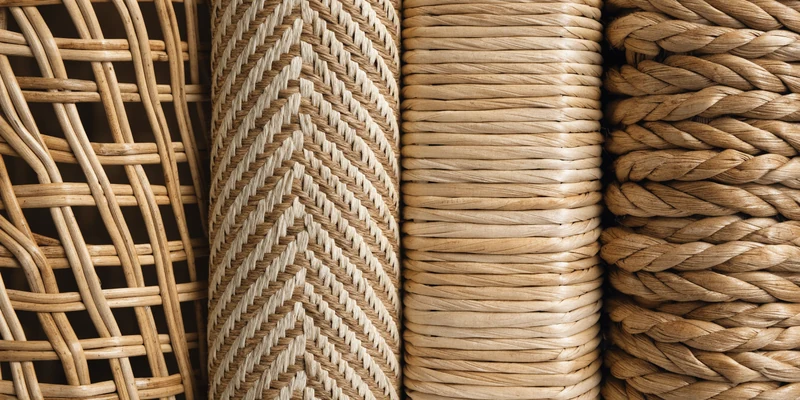
Three patterns cover the majority of furniture. Plain weave alternates one over and one under, which is the pattern in most baskets and in the body of classic wicker chairs. Twill passes over two or more strands before going under, and herringbone reverses that diagonal at intervals to make a zigzag.
Close Weave and Basket Weave
Close weave is plain weave with the rows pushed hard together so no gaps remain, which is what a firm seat needs. Basket weave, sometimes called checkerboard, groups two or three strands together in each direction and produces the square blocks you see on flat sides and table shelves.
On a synthetic outdoor set these same patterns are produced with resin strand, usually flat rather than round. The flat strand makes the pattern read more graphically, which is why resin furniture often looks more regular than natural work even at the same tightness.
Openwork and Decorative Patterns
Open patterns leave deliberate gaps, and they exist because a fully closed chair back looks heavy and traps heat against a seated body. Lattice and diamond openwork are the common ones, arranged so the gaps form a repeating grid rather than appearing at random.
Then there are the finishing details: the braided edge that caps the top rail of a chair, the rope twist run around a table rim, and the fanned strands that open out behind the shoulders on a peacock chair. These are showpieces, and they are where handwork is easiest to judge.
Cane Webbing and Its Hexagons
Cane webbing is a different production entirely. It is machine woven from cane, the peeled outer skin of the rattan stem, into a continuous sheet with the familiar open hexagon pattern, then sold by the roll and pressed into a groove around a seat or door opening.
It is the pattern behind the recent wave of cabinet doors, headboards and bed frames with woven inserts. Because it comes as sheet, a damaged panel is replaced as a unit rather than rewoven strand by strand, which makes it the most repair friendly pattern of all.
Recognizing Each Pattern
The table below is built for identifying a piece from a photograph or across a room. Look at the direction of the lines first, then at whether there are gaps, and the pattern usually names itself.
| Pattern | How to recognize it | Typical use | Practical note |
|---|---|---|---|
| Plain weave | Simple over and under, no diagonal | Chair bodies, baskets, drawer fronts | Easiest to repair yourself |
| Twill | Clear diagonal running one way | Flat panels, sides, table shelves | Uses long strand runs, looks smooth |
| Herringbone | Diagonal that reverses in bands | Decorative panels and backs | Hides small irregularities well |
| Close weave | No visible gaps, dense surface | Seats and any load bearing surface | Firmest under cushions |
| Open lattice | Regular gaps in a grid or diamond | Chair backs, screens, cabinet sides | Lighter look, flexes more |
| Cane webbing | Machine even open hexagons | Pressed seats, doors, headboards | Replaced as a sheet, not rewoven |
If the pattern is perfectly identical across the whole piece, you are looking at machine work or synthetic strand. Handwork always drifts slightly.
Which Weave for Which Job
Match the pattern to the load. Seats want close weave, because a loose surface lets cushions sink between the strands and puts all the wear on a few crossings. Backs and sides can be open, since they carry less weight and an open pattern keeps the piece from looking bulky.
For statement furniture the fan and braid work is the point, and a peacock chair is the clearest example of a piece bought for its weave rather than its function. Our guide to peacock chairs old and new covers what to look for in the fan itself.
Where the weave is the design
On a peacock chair the fanned back is the whole piece, so judge the evenness of the radiating strands before anything else.

How the Pattern Affects Cleaning and Repair
Tight weaves collect dust on the surface, where a brush and a vacuum with a soft attachment handle it easily. Open weaves let dust through to the frame and into corners, so they need the crevice tool rather than a wipe. Neither should be soaked if the fiber is natural.
For repairs, the rule is that regular patterns are forgiving and decorative ones are not. A plain or close weave can be patched with reed by following the existing path, while braided edges and fanned backs need matching technique to disappear, and that is skilled work.
Frequently Asked Questions
What is the most common wicker weave? Plain weave, one strand over and one under. It is the base pattern for most baskets and for the body of classic woven furniture, and almost every other pattern is a variation on it.
What is the difference between cane webbing and woven wicker? Cane webbing is a machine woven sheet of cane with an open hexagon pattern, pressed into a groove as a panel. Woven wicker is built strand by strand around a frame, usually from reed rather than cane.
Does a tighter weave mean stronger furniture? For seats, generally yes, since a close weave spreads load across many crossings and keeps cushions from sinking. On backs and sides an open pattern is a style choice rather than a weakness.
Can you tell handmade wicker from machine made? Usually. Handwork drifts slightly in spacing and tone across a piece, while machine weaving and synthetic strand repeat exactly. Look along a long run of weave from a low angle to see it.
Which weave is easiest to repair? Cane webbing, because the whole panel is replaced as a sheet. Among woven patterns, plain and close weave are the most forgiving, and braided or fanned decorative work is the hardest to match.
Do synthetic sets use the same patterns? Yes, though usually with flat resin strand rather than round natural strand. The patterns are the same in principle, and they look more graphic and regular because the material is uniform.
The Bottom Line
Read the weave before the styling. Close weave under a cushion, openwork where you want lightness, cane webbing where a panel might need replacing one day, and decorative braid where the piece is meant to be looked at. Knowing the pattern also tells you in advance how hard a future repair will be.