Last updated: August 20, 2026
All weather wicker patio furniture is a marketing phrase, not a standard. No agency defines it, no test certifies it, and any seller can print it on any listing. Two sets can carry the words while one is UV stabilized polyethylene over powder coated aluminum and the other is a thin PVC blend on bare steel.
This guide separates the parts of a set that genuinely handle weather from the parts that only claim to: what HDPE means next to cheaper blends, why UV stabilization decides how strands age, why the frame fails before the weave, and what you can verify on a listing.
This article contains affiliate links. If you buy through them, we may earn a commission at no extra cost to you. Learn more.
Quick Answer
What does all weather wicker actually mean?
- It is an unregulated marketing term. Treat it as a starting point, not a specification.
- The strand is what the phrase is meant to describe. HDPE and other polyethylene resins hold up far better than soft PVC blends.
- UV stabilization is the single feature that separates a set that keeps its color from one that chalks and turns brittle.
- The frame usually fails first. Powder coated aluminum does not rust; steel does once the coating is breached.
- Cushions are almost never all-weather even when the set is labeled that way. Assume they need storage or a cover.
What the Phrase Covers and What It Does Not
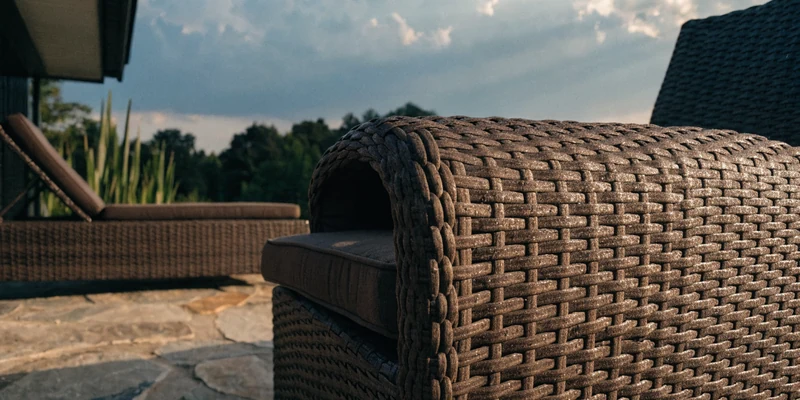
All weather wicker is meant to say one thing: the woven strand is synthetic rather than plant fiber, so rain will not swell it or rot it. That is genuinely useful information, because it rules out natural rattan for an open patio. What the phrase does not describe is the resin type, the UV package, the frame metal or the cushion fabric.
That gap matters, because those four things decide the outcome. A set can be perfectly honest in calling itself all-weather and still fade to a chalky gray in one hot summer, or hold up beautifully in the weave while the legs rust from the inside.
Weather Resistant Is Not Weatherproof
Even the best synthetic wicker is resistant rather than immune. Water pools in seat wells, freeze cycles stress the strands, and sun works on any polymer. Our guide to protecting outdoor wicker covers the off season routine.
HDPE Versus Cheap Resin Blends
The strand is the part the phrase is supposed to be about, and the resins vary enormously. High density polyethylene, usually written HDPE, is the good one: it flexes without cracking, holds pigment through the strand, and tolerates temperature swings. Soft PVC and unspecified plastic blends are the cheap alternative, and they behave differently within a year.
The tell is how the strand feels and looks. Better polyethylene has a slight give when pressed and a consistent color at the cut ends. Low grade strands feel either glassy or waxy, and the color often sits only on the surface layer.
What the Listings Do and Do Not Say
Some manufacturers state the resin outright as HDPE or PE rattan. Many say only “resin wicker,” which tells you nothing about grade. If the material section is vague, look at close-up photos of the cut strand ends and check for any stated strand thickness.
Why UV Stabilization Is the Real Differentiator
Ultraviolet light breaks polymer chains, and that is what turns a deep brown weave into a pale gray one that splinters when you sit down. UV stabilizers are additives mixed into the resin before extrusion to slow that reaction. A set with them fades slowly and evenly; a set without them can visibly change within a single hot season.
You cannot see it in a photo, so it comes down to whether the seller mentions it. Look for UV resistant, UV stabilized or fade resistant in the specification block rather than the headline. A set that says nothing about sun exposure anywhere is telling you something.
Color Choice Interacts With Sun
Darker weaves absorb more heat and show fading dramatically once it starts, while mid tone browns and grays disguise it longest. Light weaves fade less visibly but show dirt sooner. On a patio with afternoon sun and no shade, that tradeoff is worth weighing.
The Frame Fails Before the Weave
On most synthetic sets, the woven surface outlasts the metal underneath it. Powder coated aluminum is the frame you want: it does not rust, it stays light enough to move for cleaning, and it survives coastal air. Steel is stronger and cheaper, but the moment the coating is chipped at a weld or a bolt hole, corrosion starts and works outward.
Water also travels. Open tube ends sitting on wet stone wick moisture up into the frame, where you never see the rust until a leg gives way. Glides and sealed tube ends are a small detail in a listing photo and a large factor in how long a set lasts.
| Component | Better option | Weaker option | How to check the listing |
|---|---|---|---|
| Strand | HDPE or stated PE resin | Unspecified resin or soft PVC | Look for the resin named in the specifications, not the title |
| UV protection | UV stabilized additive stated | No mention of sun exposure | Search the description for UV resistant or fade resistant |
| Frame | Powder coated aluminum | Coated steel or unnamed metal | If the metal is not named anywhere, assume steel |
| Weave method | Woven over a full frame | Wrapped around a partial frame | Check photos of the underside and the seat pan |
| Cushions | Solution dyed acrylic, quick dry foam | Printed polyester, standard foam | Fabric type is usually listed under materials |
The Cushions Are Almost Never All Weather
Here is the mismatch that catches most buyers: the set is labeled all-weather and the cushions that ship with it are not. Standard included cushions use printed polyester over polyurethane foam, which soaks up rain, dries slowly from the inside, and starts smelling of mildew before the end of the first wet month.
Two upgrades genuinely change this. Solution dyed acrylic carries color through the fiber rather than on the surface, so it resists fading. Quick dry foam has an open structure that lets water drain straight through. Neither is standard, so if the listing names neither the fabric nor the foam, assume the ordinary version.
Picks by Exposure
What counts as all-weather depends entirely on which weather you have. Salt air, relentless sun and hard freezes each punish a different part of the set, so match the pick to your conditions rather than to a general durability claim. Confirm the frame material and any UV wording on the listing before ordering.
🌿 Exposed patio with no cover
For a set that sees full rain and full sun with nothing overhead, prioritize a stated polyethylene strand over a powder coated aluminum frame and accept plainer styling to get both.
🪑 Coastal and salt air
Salt attacks steel quickly, even coated steel. Aluminum framing is close to non negotiable near the ocean, and coated hardware is worth checking.

☂️ Hot sun and high UV
In desert or southern exposure, UV stabilization is the whole ballgame. Look for it stated explicitly, and consider a mid tone weave that disguises the gradual change better than a deep dark one.

🧺 Budget pick
At the entry level, put the money into the frame and the strand and expect to replace cushions sooner. A plain weave on aluminum outlasts a more decorative set built on thin steel every time.

If you plan to store the set in winter, weight and stackability matter as much as materials. Lighter aluminum pieces and chairs that stack actually get put away; sets too heavy to move stay out through every freeze.
Common Mistakes to Avoid
- Treating the phrase as a specification. All-weather tells you the strand is synthetic and nothing more.
- Ignoring an unnamed frame metal. A listing that never says aluminum usually means steel.
- Leaving cushions out because the set is all-weather. The cushions almost never share that claim.
- Pressure washing the weave. It drives water into the frame and lifts strand ends.
- Assuming a cover fixes everything. A cover over a wet set traps moisture, so let it dry first.
Frequently Asked Questions
Is all weather wicker an official standard? No. It is an unregulated marketing term with no test or certification behind it. Any seller can apply it to any synthetic weave, which is why the resin type, the UV wording and the frame material matter more than the phrase itself.
Can all weather wicker furniture stay outside in winter? It can in mild climates, and it does better everywhere with a cover. In hard freezes, resin strands become brittle and are more likely to crack under weight, so storing the set or at least covering a dry set is the safer approach.
What is the difference between HDPE and PVC wicker? HDPE is a high density polyethylene that flexes without cracking and holds pigment through the strand. PVC blends are cheaper, often softer or more brittle depending on the formulation, and tend to discolor and split sooner under sun.
Should the frame be aluminum or steel? Aluminum for anything outdoors, and especially near the coast, because it does not rust. Steel is stronger but corrodes from any chip in the powder coating, typically starting at welds and leg ends.
Are the cushions weather resistant too? Usually not. Standard cushions are printed polyester over ordinary foam and absorb water. Solution dyed acrylic covers with quick dry foam are the genuine outdoor version and are normally sold as an upgrade.
The Bottom Line
Read past the phrase. All weather wicker only promises that the strand is synthetic, so the questions worth asking are which resin, whether it is UV stabilized, whether the frame is aluminum or steel, and what the cushions are made of. A set that answers all four in its specifications has nothing to hide, and that is a better signal than any durability claim in the title.