
Last updated: August 20, 2026
People shopping for wicker chairs for dining room tables start with the weave and the color, then discover after delivery that the chair sits too low, or that the arms will not clear the table apron. Woven chairs are bought on looks and returned on measurements.
This guide is about the measurements: seat height against apron height, arms versus tucking under, width per seat, counter and bar versions, stackable outdoor sets, and how a woven seat behaves around food. Dimensions differ between sellers and model years, so use this as a list of things to compare on the listing.
This article contains affiliate links. If you buy through them, we may earn a commission at no extra cost to you. Learn more.
Quick Answer
How do you size wicker dining chairs to your table?
- Measure floor to the underside of the table apron, then compare that with the listed seat height. What is left over is thigh clearance.
- If you want the chairs to tuck away, compare apron height against the listed arm height, or buy armless.
- Divide your table edge by the overall chair width, not the seat width, to see how many seats really fit.
- Counter height and bar height are different products. Match the stool to the surface, not to the room.
- Natural rattan and cane belong indoors. Outdoor dining chairs should be resin wicker over an aluminum frame.
Match the Chair to the Table, Not the Room
Dining seating is sized to one thing: the height of the surface you eat at. A standard dining table, a kitchen counter and a bar top are three different heights, and each takes its own chair. Get that wrong and no cushion fixes it, because the fault is the distance between seat and tabletop.
The second measurement is horizontal. Chairs have to sit side by side without arms colliding, and ideally slide back underneath. If you are furnishing a patio for lounging rather than eating, start with our guide to wicker patio chairs instead.
| Table type | Chair to look for | What to compare | Watch out for |
|---|---|---|---|
| Standard dining table | Dining height chair, armless or with low arms | Floor to apron underside against the listed seat height | Arms too tall to pass under the apron |
| Kitchen counter | Counter height stool, ideally with a back | Floor to counter underside against the listed seat height | Stools sold as bar height that leave no leg room |
| Bar height table | Bar stool with a footrest ring | Seat height plus whether a footrest is included | No footrest makes a tall stool tiring to sit on |
| Patio dining table | Resin wicker on an aluminum frame, stackable if stored | Seat height and the listed overall chair width | Natural rattan or cane sold for outdoor use |
What to Buy, by Situation
Five situations cover almost every dining purchase: a full set, a pair to add character, an outdoor set that has to be stored, seating for a counter, and cushions for chairs you own.
🍽️ The full set
Four matching chairs is the standard purchase. Check the listed overall width per chair against your table edge before assuming four will fit.

🏠 The indoor pair
Two rattan or cane chairs at the ends of a wooden table changes how a dining room reads. These are indoor chairs; do not let a sunny porch tempt you.

🌤️ The stackable patio set
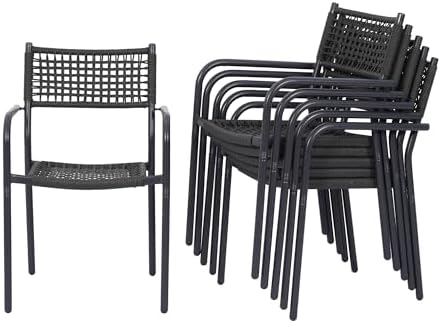
If the chairs live outside and get stored each fall, stacking beats every other feature. Check how many stack and whether they nest without scratching.
🍳 Counter height
For an island or breakfast bar, a woven stool with a back is more usable than a backless one. Compare the listed seat height with your counter, not a bar.

🪡 Cushions with ties
A woven seat gets much more comfortable with a tied cushion, and the ties keep it from sliding. Measure the seat platform and check the covers come off for washing.

Seat Height and the Apron You Forgot About
The number that decides comfort is not the seat height alone. It is the gap between the seat and the underside of the table apron, the rail that runs around the edge of the tabletop. That gap is where your thighs go. Measure floor to apron underside and compare it with the listed seat height.
Aprons vary. Some tables have deep skirts, trestle tables often have none, and glass patio tables usually have a thin frame instead. Two chairs with identical seat heights can feel fine at one table and cramped at another.
Cushions Change the Answer
A cushion raises the seat, so the clearance you measured disappears under it. If you plan to add a tied cushion, factor its thickness in before you buy, or pick a chair that starts lower. This is the usual reason a set that measured correctly still feels tight, and it applies to counter stools too.
Arms, Width and Whether the Chair Tucks Under
Arms are the reason a chair sticks out into the room. If you want chairs to slide back under the table, the arm height has to be lower than the apron underside. Armless chairs sidestep the problem and are the safer buy when floor space is tight.
Width matters just as much. Listings publish an overall width, which includes the arms and the widest point of the weave, and that is the number to divide your table edge by. Seat width alone tells you four chairs fit when in practice three do.
Woven Chairs Are Wider Than They Look
A woven back and frame add bulk a flat wooden chair does not have, and barrel style backs push the widest point out further. Leave space between chairs rather than butting them edge to edge. For a small room, armless woven chairs give the most seats per foot; see our guide to wicker chairs indoor.
Indoors or Outdoors: Be Honest About the Material
Natural rattan and cane dining chairs are indoor furniture. There is no useful hedge on this. Rattan absorbs moisture, cane webbing sags as humidity cycles, and a season on an uncovered patio leaves both out of shape.
Outdoor dining chairs should be resin wicker over a powder coated aluminum frame. That combination handles sun, rain and sprinklers, and aluminum will not rust where the coating gets scratched. Steel works too, but the coating has to stay intact.
Stacking, Storage and Sets
Stackability decides how painful winter storage is. Stackable resin chairs go into a garage corner in one column; chairs with fixed arms take several times the floor. Listings state whether a chair stacks and how many high.
Indoors, a set of four is the common purchase and a pair is how people add end chairs. If the table is on the list too, a matched rattan dining set indoor settles the sizing question.
Living With a Woven Seat Around Food
A woven seat has gaps, and gaps catch crumbs. This is the trade off the listing photos never show. A tight, flat weave sheds debris well enough; an open, chunky weave holds it, and you will be running a vacuum brush over the seats rather than wiping them.
Cleaning is otherwise easy. Resin wicker takes soapy water and a soft brush. Natural rattan and cane should only be wiped damp and dried at once, because soaking the fibers loosens the binding.
Snagging and Cushion Covers
Rough or split strands snag clothing, and the arm tops and front seat edge are where contact happens. Run a hand over those areas when the chairs arrive; a strand that catches your palm will catch a sweater. A tied cushion solves the crumbs and the snagging at once. Buy covers that unzip, because a cover that cannot go in the wash has a short life.
Common Mistakes to Avoid
- Measuring to the tabletop instead of the apron. The apron underside is what your thighs meet, and it is always lower.
- Buying bar stools for a kitchen counter. Different heights, and a bar stool at a counter jams your knees underneath.
- Dividing the table edge by the seat width. Use the overall chair width, arms included, or you order one chair too many.
- Putting natural rattan or cane outside. It is indoor furniture, and a covered porch only slows the damage.
- Forgetting the cushion in the height calculation. A tied cushion raises the seat and eats the clearance you measured.
Frequently Asked Questions
How do I know if a wicker chair will fit under my table? Measure from the floor to the underside of the table apron and compare that with the listed arm height. If the arms are taller, the chair will not tuck in.
What seat height should I look for? There is no universal figure, because tables vary. Measure your own table to the apron underside, then look for a seat height that leaves comfortable thigh clearance, allowing for any cushion you plan to add.
Can rattan dining chairs be used outside? No. Natural rattan and cane are indoor materials; moisture loosens the binding and sags the webbing. For a patio, choose resin wicker over a powder coated aluminum frame.
How many chairs fit along my table? Divide the usable table edge by the overall chair width from the listing, then leave a little space so people can pull a chair out. Woven backs are wider than they look in photos.
Are counter height and bar height stools interchangeable? No. Counter stools are made for kitchen counters and bar stools for taller bar tops. Compare the listed seat height with your own surface rather than going by the product name.
The Bottom Line
Sizing beats styling here. Measure your table from the floor to the apron underside, compare that with the listed seat height, and add the thickness of any cushion. Check arm height if the chairs need to tuck away, and divide the table edge by the overall chair width. Then choose the material honestly: rattan and cane indoors, resin wicker on aluminum for anything outside.