Last updated: August 20, 2026
Protecting wicker furniture outside is mostly about sun, not rain. Rain is the threat to natural fiber and the reason natural wicker does not belong on an open patio at all. For the resin sets that do live outdoors, ultraviolet light is what fades the color and eventually makes the strands brittle.
This guide covers what actually causes outdoor wicker to age, why position does more than any product, how to use covers without creating a damp problem, and a simple seasonal rhythm that keeps a set looking presentable for years rather than seasons.
This article contains affiliate links. If you buy through them, we may earn a commission at no extra cost to you. Learn more.
Quick Answer
How do you protect wicker furniture outside?
- Put it where the weather is not. Shade and a roof do more than any spray or cover.
- Use a breathable cover with a snug fit and tie downs, not a plastic tarp, which traps condensation underneath.
- On resin wicker, a UV protectant slows fading. On natural wicker, a suitable exterior finish is the equivalent.
- Keep the weave clean, because dirt and pollen hold moisture against the strands.
- Move cushions indoors or into a deck box between uses. They fail long before the furniture does.
What Actually Ages Outdoor Wicker
Three forces, in this order for resin: ultraviolet light, heat cycling and abrasion. Sunlight breaks down the color and the surface of polyethylene strand over years; daily expansion and contraction works the weave loose at its anchor points; grit rubs the surface dull. Rain is barely a factor.
For natural fiber the order reverses. Moisture is the primary enemy, sunlight is second, and abrasion third. That is why the same protective steps land differently on the two materials, and why a set of habits that keeps a resin sectional pristine will not save a natural chair left in the open.
Position Does More Than Any Product
A set under a pergola, a deep eave or a covered porch will outlast an identical set in full sun and open rain by years, without any product being applied to it. Before buying covers or sprays, ask whether the furniture can simply live somewhere better for most of its life.
Practical Ways to Improve the Spot
Angle the arrangement so the seats face away from the harshest afternoon sun. Add a shade sail or umbrella over an exposed grouping. Lift the feet clear of standing water on a deck or patio with glides. None of these are dramatic, and together they change the exposure profile completely.
Where a Set Should Not Go
Directly under trees that drop sap or berries, hard against a wall where air cannot circulate behind the weave, or on a low spot where water sits after rain. All three create localized problems that no cover solves.
Covers That Help and Covers That Hurt
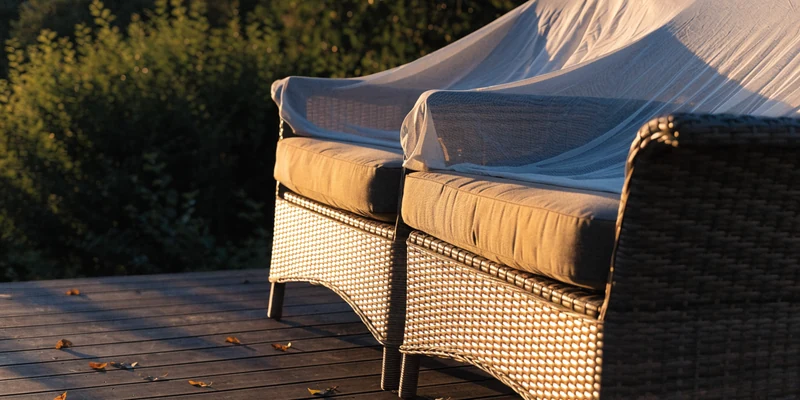
A good cover is breathable, fits closely enough not to flap, and has straps or a drawcord so wind cannot lift it. A bad cover is a plain plastic sheet, which stops rain landing on the set and then holds condensation against it, which is worse than the rain would have been.
Fit matters as much as fabric. A cover that pools water in the middle becomes a small pond that eventually finds a seam, and one that flaps in the wind abrades the very surface it is protecting. Look for vents, a shaped top and secure fastenings.

When to Use One
Covers earn their place during long spells of rain, over winter on resin sets that stay out, and when a set will be unused for weeks. Using one every single night on a set in daily use is usually more hassle than benefit, and it keeps the weave from drying between uses.
Slowing Down the Sun
On resin wicker, a UV protectant made for outdoor plastics restores some surface color and slows further fading. It is a maintenance product rather than a coating, so it needs reapplying through the season, and it works best on a set that is clean and dry when it goes on.
On natural wicker kept on a porch, the equivalent is an appropriate exterior finish, reapplied on the schedule the product specifies. Neither approach stops fading, and both are far more effective as prevention on a newer set than as a rescue on one that has already gone chalky.
A Seasonal Rhythm That Works
Protection is a handful of small jobs spread across the year rather than one big effort. The table below splits them by material, since natural and resin need attention at different points. Cleaning appears in both columns because dirt in the weave holds moisture against the strands.
| Time of year | Natural wicker | Resin wicker |
|---|---|---|
| Start of season | Clean, inspect, refresh the finish if due | Wash, rinse, apply UV protectant |
| Midsummer | Quick clean, check for loose strands | Rinse off pollen and dust, reapply protectant |
| After a storm | Dry it out fully before use | Rinse debris out of the weave |
| End of season | Clean, dry, move indoors | Clean, dry, cover or store |
The end of season step is where most of the lifespan is won or lost. Our guide to storing wicker furniture for winter covers the details for both materials, including what to do when there is no garage available.
Cushions and Fabric Need Their Own Plan
Cushions are the shortest lived part of any outdoor set, because foam absorbs water and holds it while the weave around it dries. Stand them on edge after rain rather than leaving them flat, and store them somewhere dry between uses rather than under a cover with the furniture.
Fabric choice matters at purchase. Solution dyed acrylic covers hold color under sun far better than printed polyester, and removable covers can be laundered when a fixed one cannot. If a set is going to live in real weather, the cushion specification is worth as much attention as the weave; our guide to all weather wicker patio furniture covers what to check on a listing.
Frequently Asked Questions
Should you cover wicker furniture outside? During long wet spells, over winter and when a set will be unused for weeks, yes. Use a breathable, close fitting cover with straps. Covering a set in daily use every night usually traps more moisture than it keeps out.
Does resin wicker fade in the sun? Yes, over years. Ultraviolet light is the main thing that ages polyethylene wicker, and it shows first on the surfaces facing the afternoon sun. A UV protectant applied to a clean, dry set slows the process but does not stop it.
Can you use a tarp to cover patio furniture? It is better than nothing in a storm and poor as a routine solution. Plastic tarps do not breathe, so condensation forms underneath and sits against the weave and the cushions, which is exactly the condition you were trying to avoid.
How do you keep outdoor wicker from cracking? Keep it out of full sun where you can, keep the weave clean, and use a UV protectant on resin sets. Cracking on resin is usually the end stage of sun damage, and once it starts across a set it cannot be reversed.
Can natural wicker be treated to go outside? A finish slows moisture uptake but does not make natural fiber weatherproof, and a sealed piece that gets soaked can trap moisture underneath the finish. Treat natural wicker as porch furniture rather than patio furniture.
How often should outdoor wicker be cleaned? A wash at the start of the season, one in midsummer and one before storage suits most sets, with a rinse after heavy pollen or a dust storm. Dirt in the weave holds moisture, so cleaning is part of protecting.
The Bottom Line
Position first, products second. Shade and a roof do more for outdoor wicker than anything you can spray on it. Use a breathable, close fitting cover for long absences and winter rather than every night, apply a UV protectant to clean dry resin sets through the season, keep the weave clean because dirt holds moisture, and give the cushions their own storage plan.