Last updated: August 20, 2026
Cane vs rattan looks like a comparison between two materials, and it is really a comparison between a plant and one part of that plant. Cane is the outer skin of the rattan stem, peeled off in long strips. Rattan is everything: the pole, the skin and the core inside it.
That single fact explains most of the confusion in furniture listings, and it also explains why cane behaves so differently from woven rattan once the piece is in your house. This guide covers the terms, the uses and what each one means when something needs repair.
This article contains affiliate links. If you buy through them, we may earn a commission at no extra cost to you. Learn more.
Quick Answer
What is the difference between cane and rattan?
- Rattan is the whole climbing palm stem. Cane is only its outer skin, cut into narrow strips.
- The soft inner core of that same stem is milled into reed, which is the strand used for classic wicker weaving.
- Cane is hard, glossy and slippery, so it resists stain and paint. Reed is porous and absorbs both.
- Cane usually appears as a flat woven panel in a seat, a chair back or a cabinet door. Rattan usually appears as the frame around it.
- Both are indoor materials. Neither belongs on an uncovered patio.
Cane Comes Out of Rattan
A harvested rattan stem is not used whole. The tough shiny bark is stripped away first and cut into even strips, and those strips are cane. What remains underneath is a pale porous core that gets milled into round or flat reed. One stem, three products, three completely different jobs in a workshop.
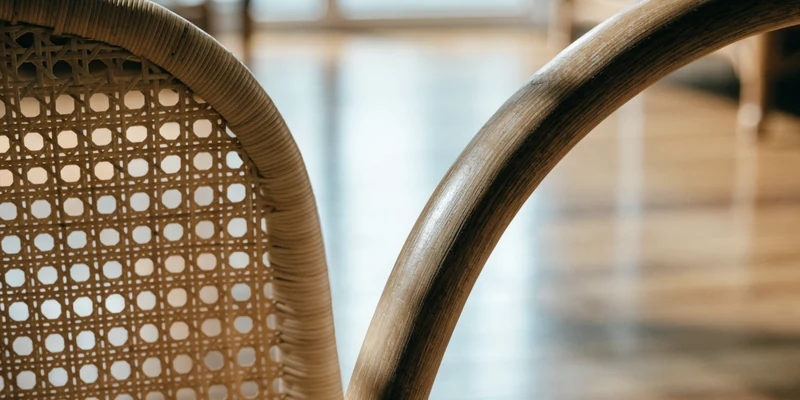
Once you hold that picture, listings stop contradicting themselves. A chair described as a rattan frame with a cane seat is not mixing up its terms. It is telling you the structure came from the pole and the seat panel came from the skin of the same plant.
What Cane Means on a Product Page
Cane appears in furniture in two forms and the difference decides how the piece is repaired. Sheet cane, also sold as cane webbing, is a pre woven roll with the familiar open hexagon pattern. Strand cane is loose lengths, hand threaded through a ring of drilled holes around a seat opening.
Pressed Cane and Hand Caning
Pressed cane means webbing set into a groove routed around the opening and locked in place with a wedge of reed called a spline. If you can see a continuous groove with a strip pressed into it, that is what you have, and replacing it is a straightforward afternoon job.
Hand caning means individual strands woven through drilled holes, with no groove and no spline. That is slower work and it is what most antique chairs use. Look at the underside of the frame before you plan any repair, because the two systems are not interchangeable.
The Terms Sorted Out
Five words cover almost every use of the plant in a furniture description. They overlap in daily speech, but each one names a specific part of the stem or a specific technique, and telling them apart is what stops you buying the wrong repair material.
| Term | What it is | Where you see it |
|---|---|---|
| Rattan pole | The whole stem, solid through, steam bent into shape | Chair frames, bed frames, curved arms and backs |
| Cane | The peeled outer skin, cut into narrow strips | Seat panels, chair backs, cabinet and headboard inserts |
| Cane webbing | Cane pre woven into a sheet, sold by the roll | Pressed cane seats and modern fluted cabinet doors |
| Reed | The soft inner core, milled round or flat | Woven wicker bodies, wrapping, repair strand |
| Binder cane | Wider cane used to cover the edge of a caned panel | The finished border around a hand caned seat |
Buying reed when the job needs cane is the most common mistake in a first repair, and the two do not look alike once you have seen them side by side.
How Each One Behaves in a Room
Cane is stronger than it looks and it works partly by tension, so a caned seat should feel slightly springy rather than dead flat. It also responds to the air around it. Dry indoor heat over a winter makes a panel loosen and sag, while normal humidity keeps it taut.
The traditional fix for a sagging but unbroken panel is to wet it. Sponging the underside with warm water and letting the seat dry away from direct heat lets the fibers shrink back and tighten. It does nothing for broken strands, but it revives a great many seats that owners had written off.
Repairing Cane and Repairing Rattan
These are separate skills with separate supplies. A cane panel is replaced as a unit: cut the old spline out, clean the groove, soak the new webbing until it is pliable, press it into the groove and glue the spline back over it. A broken wicker weave is repaired strand by strand with reed instead.
Match the spline to the groove rather than guessing, since splines come in a range of widths and one that is too narrow will lift out again within a season. Our roundup of wicker repair kits and materials covers what belongs in a first kit.
For a pressed cane seat
Cane webbing is sold by the roll in a few mesh sizes, and matching the mesh of the original panel is what makes the repair invisible.

For a broken wicker weave
Reed strand in assorted widths is the material for patching a woven body, since cane is too stiff and too glossy to blend in.

Which One to Choose When Shopping
You rarely choose between them, because most pieces use both. What you do choose is how much of the visible surface is cane webbing, and that is a style decision. Cane panels read light and airy and let a room breathe, while a fully woven rattan body reads solid and textural.
There is a practical angle too. A cane panel is a single sheet that can be replaced cleanly years later, while a damaged woven body has to be patched by hand and never quite disappears. If the piece will get daily use, the panel is the easier long term commitment.
Frequently Asked Questions
Is cane the same as rattan? No. Cane is the outer skin peeled from a rattan stem, so it comes from rattan but is only one part of it. The inner core of the same stem is sold as reed, and the whole stem is used as pole for frames.
Is cane furniture stronger than rattan furniture? They do different jobs. Cane works in tension as a woven panel and rattan pole works in compression as a frame, so a well made chair uses cane for the seat and rattan for the structure rather than choosing between them.
Can you paint cane webbing? You can, but it takes paint poorly compared with reed. The natural surface of cane is hard and glossy, so a light spray in thin coats works better than brushing, and heavy coats will clog the open mesh.
Why is my cane seat sagging? Usually dry air rather than damage. Sponging the underside with warm water and letting the seat dry naturally lets the fibers shrink and tighten again, which works whenever the strands themselves are still intact.
What is the difference between cane webbing and hand caning? Webbing is pre woven sheet cane pressed into a routed groove and held by a spline. Hand caning is individual strands threaded through drilled holes. Check the underside of the frame to see which one you have.
Can caned furniture go outdoors? No. Cane absorbs moisture, and repeated wetting and drying loosens the panel and eventually splits the strands. Keep caned pieces indoors or on a fully covered porch.
The Bottom Line
Cane and rattan are not rivals, they are parts of the same plant doing different jobs. Rattan pole gives a chair its shape, cane gives it a light woven panel, and reed patches the woven body when something breaks. Buy the right one of the three for the job in front of you and keep all of them out of the rain.