Last updated: August 20, 2026
How to repair wicker furniture starts with an honest sort into three piles: things a beginner can fix in an evening, things that need a specialist, and things that are simply finished. Natural wicker is repairable because the material is still made and sold. Resin wicker mostly is not, because the strand is proprietary to the set.
This guide covers the failures you actually meet on a real piece, the technique for splicing new reed into natural weave, what to do about a sagging seat or a wobbling frame, and the point where continuing to repair a piece stops making sense.
This article contains affiliate links. If you buy through them, we may earn a commission at no extra cost to you. Learn more.
Quick Answer
Can you repair wicker furniture yourself?
- Natural wicker, yes for most common damage. Reed and cane are sold by the coil and splice into an existing weave.
- Soak natural reed before you bend it. Dry reed cracks; damp reed follows the weave.
- Resin wicker is harder, because matching strand is rarely available and the color has usually faded away from new stock.
- Loose frames and sagging seats are frame problems, not weave problems, and they get fixed first.
- Stop when several strands have failed in the same area, when the frame itself is rotten, or when the seat no longer holds shape.
What Is Repairable and What Is Not
Natural wicker is repairable in a way almost no other furniture is, because the raw material has not changed in a century. Reed, cane and binder cane are still sold by weight and width, and a patient amateur can splice a new length into an existing weave invisibly enough for a porch chair.
Resin wicker sits at the other end. The strand profile is specific to the manufacturer and often to the model year, replacement stock is rarely sold to consumers, and any new strand you do find will be a different shade from the faded original. Repairs there are structural rescues, not restorations.
The Four Failures You Will Actually Meet
Almost every wicker repair falls into one of four categories: a strand that has broken or sprung loose, binding that has unravelled at a joint, a seat that has stretched and sagged, or a frame that has loosened at its joints. Each has a different fix and a different difficulty level.
| Damage | Natural wicker | Resin wicker | Difficulty |
|---|---|---|---|
| Broken strand | Splice in soaked reed and tuck the ends | Needs matching strand, rarely available | Moderate on natural |
| Unravelled binding | Rewrap with binder cane and glue the tail | Tuck and secure with adhesive | Easy |
| Sagging seat | Re-tension or reweave the seat panel | Usually not fixable in place | Hard |
| Loose frame joint | Reglue and clamp, or add a screw where hidden | Tighten the frame hardware | Easy to moderate |
Work in that order rather than the order the damage catches your eye. A weave repaired on a frame that still moves will fail again in the same place.
Splicing a Broken Strand in Natural Wicker
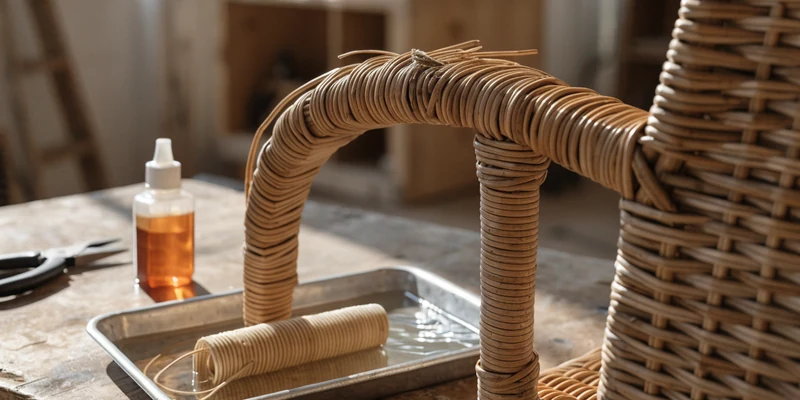
The core technique is simple: soak new reed until it bends without cracking, trim the broken strand back to a point where it is still held by the weave, then thread the new length along the same path, overlapping the old ends inside the weave rather than at the surface.
Soaking and Sizing
Reed needs to be pliable before it goes anywhere near a curve, and warm water for a short period does that; the exact time depends on the thickness, so test it by bending a scrap. Match the width of the new reed to the old as closely as you can, since a slightly narrow strand disappears better than a slightly wide one.

Weaving It In
Follow the existing over and under pattern exactly. Pull the strand snug but not tight, because reed shrinks as it dries and a strand pulled hard while wet will distort the surrounding weave. Secure the ends underneath with a small amount of wood glue and hold them with clips or clothespins while it sets.

Sagging Seats and Loose Frames
A sagging wicker seat is usually the result of years of load plus repeated damp and drying cycles, and it is the hardest thing on the list to fix well. Support from underneath, in the form of a fitted board or a stretcher, is the practical answer for a chair you want to keep using.
Loose frames are much easier. Older natural pieces are built on hardwood frames, and joints that have opened can be cleaned out, reglued and clamped like any other furniture joint. On resin sets the frame is aluminum or steel, and a loose piece almost always means hardware that has backed out and needs tightening.
Repairing Resin Wicker Realistically
For polyethylene wicker, the achievable repairs are tucking a loose end back into the weave and securing it, replacing a whole section only when the manufacturer sells replacement strand, and tightening or replacing the frame hardware underneath. Anything more ambitious tends to look worse than the damage did.
Two practical notes. Heat softens the strand and can be used carefully to tuck an end, but too much deforms it permanently. And a repair on a sun faded set will always be visible, because new strand carries its original color while the surrounding weave does not. Preventing the damage is the better strategy; our guide to protecting wicker outside covers what actually helps.
When to Stop Repairing
Three signals say a piece is done. Multiple failed strands in the same area, because fixing one transfers the load to its neighbors. A frame that is soft or rotten rather than merely loose. And a seat that no longer holds its shape under normal use, which is a structural failure rather than a cosmetic one.
There is also a value judgment. A well made antique natural piece justifies real effort. A mass produced resin set does not, and the hours are better spent choosing a replacement. If your piece falls on the worth saving side, our guide to wicker repair kits covers the reed, cane and tools to buy before you start.
Frequently Asked Questions
Can broken wicker be repaired? On natural wicker, yes. Reed and cane are still sold by the coil, and a broken strand can be trimmed back and spliced with new material that follows the same weave path. On resin wicker it depends entirely on whether matching strand is available.
What glue works on wicker furniture? Standard wood glue holds spliced ends and reglued frame joints on natural wicker. On resin wicker, an adhesive rated for polyethylene is needed, and even then it is holding a tucked end rather than making a structural bond.
How do you fix a sagging wicker seat? Properly, by re-tensioning or reweaving the seat panel, which is specialist work. Practically, by supporting it from underneath with a fitted board or stretcher, which keeps a usable chair usable without restoring the weave.
Do you have to soak wicker before repairing it? Natural reed and cane, yes. Dry material cracks the moment it is bent around a curve. Soak until it flexes without splitting, then work quickly, since it stiffens again as it dries.
Can you replace strands on resin wicker furniture? Only if the manufacturer sells replacement strand for that range, which most do not offer to consumers. Where it is available, the new strand will not match the faded color of the surrounding weave.
Is it worth repairing old wicker furniture? For a well built natural piece with sound framing, usually yes, since the material and the technique are both still current. For a mass produced resin set with several failed strands, the effort rarely pays back.
The Bottom Line
Fix the frame first, then the weave. Natural wicker splices well with soaked reed and a little patience, and a chair repaired this way lasts years. Resin wicker offers tucking, gluing and hardware tightening, and not much else, because matching strand is rarely sold and never matches the faded original. When several strands fail in one area or the frame goes soft, stop repairing and start shopping.