Last updated: August 20, 2026
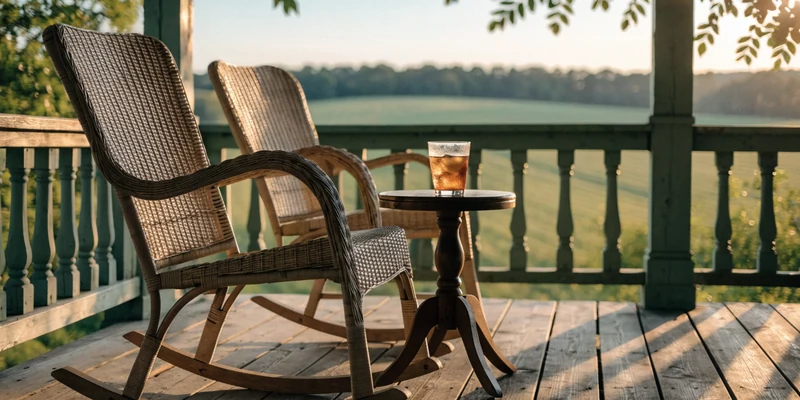
Wicker rocking chairs for porch use are the shape most people picture when they imagine sitting outside doing nothing in particular. The catch is that a rocker is fussier about its spot than any other patio chair: it needs floor behind it, a level surface under it, and a frame that does not creak.
This guide covers the decisions that matter before you order: runner shape and clearance, resin weave versus natural rattan, frame metal and creaking, seat height, one chair or a pair, and cushions that stay put. Specifications shift between model years, so confirm dimensions and materials against the current listing.
This article contains affiliate links. If you buy through them, we may earn a commission at no extra cost to you. Learn more.
Quick Answer
How do you choose a wicker rocking chair for a porch?
- Measure the clearance behind the chair first; a rocker against a railing barely moves.
- Open porch: all-weather resin weave over an aluminum or coated steel frame.
- Covered porch, sunroom or nursery: natural wicker is on the table.
- Long runners rock slow and wide; short runners suit tighter porches.
- Buy the pair with a side table if two people ever sit out there.
Rocker styles and what each one needs
Most porch rockers fall into four groups: the classic long-runner rocker, the compact short-runner version, the swivel rocker that pivots instead of travelling, and the glider on a hinged base. They differ mainly in floor space, in how the motion feels and in how many parts can work loose.
| Rocker style | Best for | Motion | Space it needs |
|---|---|---|---|
| Classic long-runner rocker | Deep covered porches | Slow, wide travel | Clearance behind, on a flat surface |
| Compact short-runner rocker | Narrow porches, balconies | Shorter, quicker arc | Least of the four, but not flush to a wall |
| Swivel rocker | Fire pits, views in two directions | Gentle rock plus a full turn | A turning circle, not clearance behind |
| Glider | Porch boards you would rather not scuff | Level, gliding motion | Fixed footprint; check the hardware |
On a shallow porch a swivel rocker or a glider is often the honest answer, since neither travels backward the way a runner does. Our wicker swivel chair guide covers the mechanisms in detail.
Picks for different porch setups
These five picks cover common situations rather than ranking chairs: a single outdoor rocker, a matched pair with a table, a chair that arrives with its cushion, a rocker for indoor use, and replacement cushions with ties.
🌾 The straightforward porch rocker
One resin wicker rocker suits a porch where the second seat rarely fills. Check the listed seat height and overall depth, since the depth figure usually includes the runners.

👥 A pair with a table between
Two rockers and a small table is the classic front porch arrangement, and a matched set spares you the job of pairing pieces later. Confirm that the table height suits the arms and that the set ships in one delivery.

☔ For a porch that gets weather
A resin chair sold with its cushion saves the guesswork of matching one later. Look for a material line naming PE or HDPE strand and a frame described as aluminum or powder coated.

🏠 For a nursery or a sunroom
A white wicker rocker indoors is a different purchase: lighter, often natural fiber, chosen on looks and quiet motion. Check the manufacturer information on assembly and use before it becomes a nursery chair.

🧵 Cushions that stay put
A rocking chair moves, so a cushion without ties slides forward within a week. Replacement sets with back and seat ties fix a chair that is otherwise sound.

Runners, clearance and the floor underneath
A rocker travels backward as it moves, so it needs floor behind it that a stationary chair does not. Longer runners give the slow, wide motion people associate with porch rocking and need the most room; shorter runners suit tight spaces but feel quicker and less settled.
How much room to leave
Rather than trusting a rule of thumb, take the overall depth from the listing, add room for the chair to tip back, and mark that on the porch floor with tape before you order. The check takes minutes and prevents the common regret, a rocker that thumps into the railing halfway through its motion.
What the surface does to the motion
Runners want a flat, hard surface. Wide-gapped decking, flagstone and gravel catch the runner and make the rock stutter, and an outdoor rug tends to bunch instead of helping. Concrete, tight porch boards and composite decking all work.
Resin or natural wicker, and what is under the weave
Most chairs listed as wicker rockers are resin strand woven over a steel or aluminum frame, not cane. That is good news for an open porch, since natural rattan swells, grays and eventually splits once it gets rained on. Natural wicker rockers belong on a covered porch or indoors, and no sealant changes that.
Reading the material line
The photograph will not tell you which you are looking at, because good resin imitates cane closely. The material description does: PE, HDPE, synthetic rattan or all-weather means resin, while rattan or cane with no weather claim means an indoor chair. Color follows practical logic too: dark brown hides pollen, while white and light gray show every mark.
Frame metal and the creaking question
Aluminum stays light, will not rust and suits coastal or poolside porches. Powder-coated steel is heavier and steadier in wind, but a chipped coating turns into a rust spot the weave hides until it spreads. Creaking usually traces back to bolts that loosened in the first weeks, so check the hardware after a month.
Seat height, getting out, and cushions
A rocker that is comfortable to sit in can still be awkward to leave, because the chair moves when you push off the arms. Seat height and arm design decide how that feels, and they matter more than the weave pattern for anyone who sits out there daily.
Seat height and arm support
Deeply reclined rockers are relaxing to sit in and harder to rise from, while an upright seat with firm, forward-reaching arms is easier to leave. Listings publish seat height, so compare it to a dining chair at home you stand up from easily. Wide flat arms also hold a mug; a narrow rolled arm does not.
Cushions and tie-downs
Cushions on a rocker need ties or a non-slip backing, because the motion works an untethered cushion forward until it hangs off the front edge. Look for covers that unzip and wash and a thickness that suits the seat. Our cushion guide covers measuring and fabric.
One chair or a pair
A single rocker reads as a reading spot; two rockers with a table between them read as a place to sit with someone. If the porch holds the pair, the pair gets used more, and set listings usually work out better than pieces bought separately.
Rockers need not match the rest of the porch either. Two of them beside a stationary bench give people a choice of motion, and a consistent weave color ties the mix together. See the overview of wicker patio chairs for the other shapes.
Common Mistakes to Avoid
- Forgetting the clearance behind the chair. Against a railing a rocker stops mid-arc and never feels right.
- Buying natural wicker for an open porch. Cane and rattan need a roof; resin strand does not.
- Setting a rocker on gravel or wide-gapped decking. The runners catch and the motion stutters.
- Choosing a cushion without ties. The motion walks it off the seat within days.
- Ignoring the hardware after assembly. Most creaks are loose bolts that a wrench fixes in a minute.
Frequently Asked Questions
Can a wicker rocking chair stay outside year round? An all-weather resin chair on an aluminum frame generally can, with the cushion stored indoors and a cover in wet regions. A natural wicker rocker should not.
How much space does a rocker need behind it? Take the overall depth from the listing, allow extra for the backward travel, and mark it on the floor with tape. Porch depth varies too much for one number to help.
Why does my wicker rocker creak? Almost always loose hardware where the runners meet the frame, not the weave. Tighten the bolts after the first few weeks and each season. Persistent creaking on a new chair is worth raising with the seller.
Is a wicker rocking chair suitable for a nursery? Many people use one indoors, choosing a quiet motion and a washable cushion. Check the manufacturer information on assembly and use rather than assuming an outdoor model transfers indoors.
Rocker or glider for a small porch? A glider, usually. It moves within a fixed footprint instead of travelling backward, so it fits where a runner rocker would hit the railing.
How do I clean the weave? Mild soap, water and a soft brush along the strands, twice a season. Avoid pressure washers, which loosen the wrap where the strand ends at the frame.
The Bottom Line
Choose the rocker around your porch, not the photograph. Measure the clearance behind the chair first, since that one number rules out half the options. On an open porch buy resin strand over aluminum or coated steel, and save natural wicker for a covered porch or indoors. Then check seat height, insist on cushions with ties, and tighten the hardware after a few weeks.