Last updated: August 20, 2026
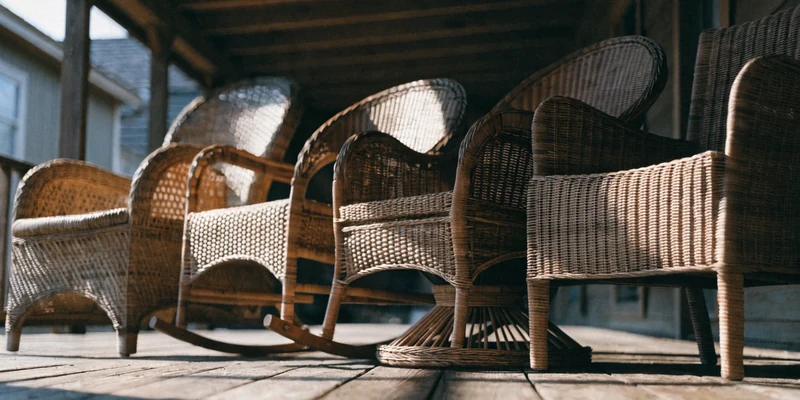
Wicker patio chairs are not one product but a family of shapes, and the shape you choose decides how the porch actually gets used. A rocker invites long sitting. A dining chair pulls up to a table and disappears against it. A swivel rocker lets one seat face a fire pit, a yard and a conversation without being dragged across the deck.
This guide sorts the chair types, says which porch or patio situation each suits, and hands off to the deeper guides where a style deserves a closer look. Weave material, frame metal and cushion thickness change from one model year to the next, so confirm the details against the current listing before you order.
This article contains affiliate links. If you buy through them, we may earn a commission at no extra cost to you. Learn more.
Quick Answer
Which wicker patio chair style fits your porch?
- Open to sun and rain: all-weather resin weave over an aluminum or powder-coated steel frame.
- Fully covered porch or sunroom: natural rattan is possible, but it never sees weather.
- Narrow porch or balcony: dining chairs or a compact club chair, since rockers need clear floor behind them.
- Deep porch with a view: a rocker, glider or swivel rocker earns its footprint.
- Seating three or more people: a loveseat or sofa beats lining up single chairs.
Wicker patio chair types at a glance
Six shapes cover almost everything sold as outdoor wicker seating: the stationary club or lounge chair, the rocker, the swivel rocker or glider, the dining chair, the hanging egg chair and the loveseat or sofa. They differ less in comfort than in how much floor they need and how often you plan to move them.
| Chair type | What it suits | Watch out for |
|---|---|---|
| Club or lounge chair | Everyday patio seating, corners, pairs with an ottoman | Deep seats can leave shorter sitters perched; check seat depth on the listing |
| Rocking chair | Covered front porches, long evenings, a traditional look | Needs clear floor behind the runners and a flat surface |
| Swivel rocker or glider | Fire pits, decks with a view, groups that shift around | Moving parts add weight and can rattle; check the base and hardware |
| Dining chair | Patio tables, small balconies, seasonal storage | Thin or no cushion means shorter sittings; not a lounging seat |
| Hanging or egg chair | One reading corner, a shaded spot, a visual anchor | Stand footprint is wide; mounted versions need manufacturer instructions |
| Loveseat or sofa | Families, three or more people, conversation groupings | Hard to move alone; measure the gate, path and doorway first |
If your porch fits two chairs and a small table, the real decision is between a stationary pair and a rocking pair. Deeper spaces open up seating groups and swivel chairs, because people can then face each other instead of all facing the yard.
Picks by porch situation
These five picks are starting points rather than a ranking. Each answers a different situation: a plain pair for a patio, a rocker for a covered porch, a swivel set around a fire pit, a lounge chair with a footrest, and cushions for a frame that is still sound.
🪑 The default pair for an open patio
Two matching resin wicker chairs with a small table between them handle most patios without committing you to a full seating group. Check whether the listing includes cushions, and whether the frame is aluminum or steel.

🌾 The covered front porch classic
A wicker rocker is the shape people picture when they think of a porch, and it suits a spot where you sit for a while rather than pass through. Our full wicker rocking chair guide covers runner shapes and clearance in detail.

🔄 Around a fire pit or facing a view
Swivel rockers let one seat serve two directions, which suits decks where the view and the conversation sit on opposite sides. Look for a listing that names the base material and the assembly required.

🦶 For putting your feet up
A club chair with a matching ottoman turns a corner of the patio into the seat everyone claims first. The ottoman doubles as a tray table, so it earns its space even when nobody is sitting.

🧵 When the frame is fine and the cushions are not
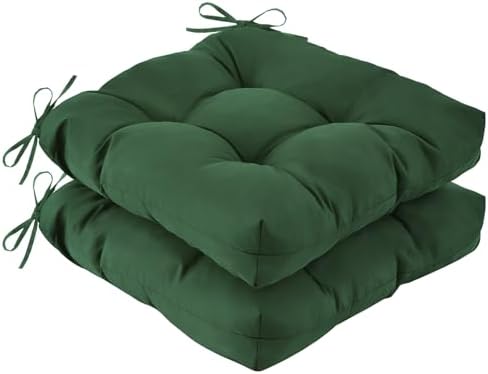
Faded, flattened cushions age a set faster than the weave does. Replacing them is the simplest way to make an existing chair worth sitting in again, provided you measure the seat before ordering.
Resin wicker or natural rattan outdoors
Natural rattan is an indoor material. It is a plant fiber, it absorbs water, and left on an open porch it will swell, gray out and eventually split at the joints. What survives outside is all-weather resin wicker, a synthetic strand woven over a metal frame, and that is what nearly every outdoor listing means by wicker.
What all-weather resin actually is
Resin wicker is extruded plastic strand, usually listed as PE or HDPE, wrapped around a frame in a weave that imitates cane. Better versions are UV stabilized so the color holds through summers of direct sun; weaker strand fades, grows brittle and cracks. The listing should say whether the strand is UV treated, and owner photos taken after a season tell you more than the studio shot.
Where natural wicker still makes sense
A screened porch, a three-season room or a sunroom is a different story. Under a roof, out of blowing rain, natural rattan holds up for years and looks better than any synthetic imitation of it. If that describes your space, the choices in our indoor wicker chair guide open up considerably.
Frames, seat depth and cushions
The weave is the part you see; the frame is the part that decides whether the chair lasts. Under the strand there is almost always metal, and the two common choices behave very differently in a coastal or humid yard. Seat dimensions and cushion quality then decide whether you actually enjoy sitting in it.
Aluminum versus steel
Aluminum will not rust, stays light enough to move with one hand and is the safer choice near salt air or a pool. Powder-coated steel is heavier and stays put in wind, but any chip in the coating becomes a rust spot. Check the product details, since photographs cannot tell you which metal is under the weave. If the chairs get carried into a shed each fall, aluminum changes how often that happens.
Seat depth, height and cushion fit
Deep lounge seats photograph well and can be awkward in practice, because a shorter sitter ends up perched on the front edge or swallowed by the back. Dining and porch chairs sit more upright and are easier to leave. Listings publish seat height and depth, so compare those against a chair at home you find comfortable.
Cushions carry most of the comfort and most of the wear. Look for covers that unzip and wash, fabric made for outdoor use, and ties that stop the cushion sliding. Our guide to wicker chair cushions covers measuring and fabric.
Stacking, storage and off-season care
Only dining chairs stack reliably; rockers, swivels and club chairs do not, and their footprint is what you live with year round. Decide before you buy where the set goes in winter, because a set with nowhere to go spends the off-season getting rained on.
What actually needs to come inside
Cushions are the priority. Fabric left out through a wet season grows mildew along the seams, and stacking cushions in a bin beats cleaning them later. Resin frames tolerate cold, though a breathable cover keeps grit out of the weave. Clean the weave with mild soap and a soft brush twice a season, and skip pressure washers, which can loosen the wrap at the frame.
Common Mistakes to Avoid
- Buying natural rattan for an open patio. No sealant turns an indoor material into an outdoor one.
- Skipping the rocking clearance. Against a railing a rocker stops short and never feels right.
- Ignoring the frame metal. Steel near salt air rusts wherever the coating chips, and the weave hides it.
- Assuming cushions are included. Many listings style the photo with cushions and ship only the chair.
- Buying single chairs for a group. Four separate chairs eat more floor than a loveseat plus two chairs.
Frequently Asked Questions
Can wicker patio chairs stay outside all year? All-weather resin over an aluminum frame can, provided the cushions come inside. A breathable cover helps in wet winters. Natural rattan should not stay outdoors in any season.
How do I tell resin wicker from natural on a listing? Read the material line, not the photo. PE, HDPE, all-weather or synthetic rattan mean resin. Rattan or cane with no weather claim means indoor furniture.
Which type is best for a small porch? Dining chairs or a compact club chair, since they sit close to the wall and tuck away. Rockers and swivels need clearance a narrow porch rarely has.
Do wicker chairs need cushions? Dining chairs are usable without one. Lounge and club chairs are designed around a cushion and are uncomfortable bare. Check seat dimensions before ordering replacements.
Are swivel rockers worth the extra complexity? Around a fire pit or on a deck with one view, yes, since a single chair covers two orientations. On a plain patio the mechanism mostly adds weight.
Can I mix chair types in one set? Yes, and it often looks better than a matched showroom set. Keeping the weave color and cushion fabric consistent ties mixed shapes together.
The Bottom Line
Start with the space and the material, not the style photo. All-weather resin over aluminum survives an open patio, natural rattan belongs under a roof, and the chair shape follows from how deep your porch is and how long people sit there. Rockers and swivels need clearance and reward it, dining chairs suit tight spaces, and a loveseat serves a group better than a row of singles.