Last updated: August 20, 2026
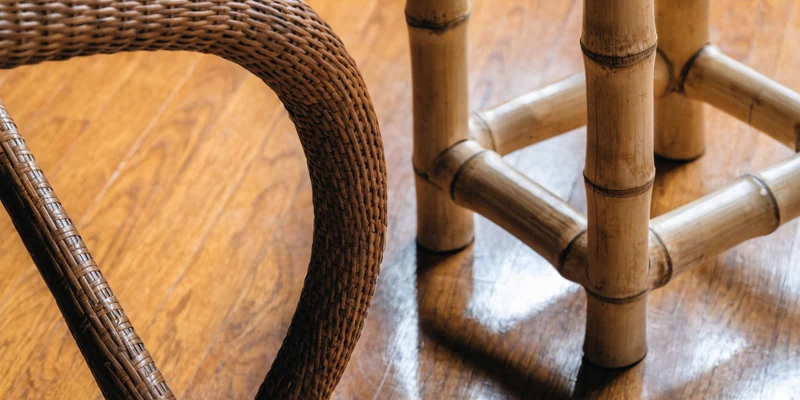
Rattan vs bamboo is settled by one structural fact: rattan is solid all the way through and bamboo is hollow. A rattan pole can be steamed and bent into a chair arm that holds its curve, while a bamboo pole under the same treatment splits along its length.
That difference decides what each plant is good for, how furniture made from them is built, and how you tell them apart in a secondhand listing where the seller has clearly guessed. This guide covers all three.
This article contains affiliate links. If you buy through them, we may earn a commission at no extra cost to you. Learn more.
Quick Answer
How do rattan and bamboo differ?
- Rattan is a climbing palm with a solid stem. Bamboo is a grass with a hollow stem divided by ridged nodes.
- Rattan bends after steaming and keeps the curve, which is why nearly all curved woven furniture is rattan.
- Bamboo is stiff and splits when bent hard, so it is used as straight poles, flat splits and panels.
- Look at a cut end. Hollow with a wall around it is bamboo, solid all the way across is rattan.
- Both are indoor materials. Neither survives an uncovered patio through a full year.
Solid Stem Against Hollow Tube
Rattan grows as a long thin climbing palm that hauls itself up through the forest canopy, and its stem is dense right through the middle. Bamboo is a giant grass that grows fast and straight, and its strength comes from a hollow tube walled off at intervals by the nodes you can see on the outside.
Both are strong, but strong in different directions. A hollow tube resists compression brilliantly, which is why bamboo scaffolding works. A solid flexible rod can be curved without failing, which is why every bentwood rattan chair back exists and why no one builds the same thing from bamboo.
What Each One Becomes
Rattan is processed into three furniture materials: poles for frames, peeled skin sold as cane, and the milled inner core sold as reed for weaving. That range lets a single plant supply the whole chair, structure and surface together, which no other furniture fiber manages.
Where Bamboo Fits
Bamboo turns up as straight pole sections for frames, as flat splits woven into mats and panels, and as engineered board made from strips glued together. In woven furniture it is usually the frame or a decorative pole detail rather than the weave, since it will not curve tightly.
A lot of furniture called bamboo is really a bamboo look. Faux bamboo turned in wood or cast in metal, with carved rings imitating the nodes, has been made for well over a century and is still produced today. The rings are too regular and the joints too perfect.
Telling Them Apart in Thirty Seconds
Four checks settle it without any expertise. Look at the cut ends, run a hand along the pole for nodes, check whether the diameter tapers, and see whether anything on the piece is curved. Any two of those agreeing is enough to be confident about what you are looking at.
| Check | Rattan | Bamboo |
|---|---|---|
| Cut end | Solid across the whole face, small pores visible | Hollow center with a distinct wall |
| Surface | Smooth, faint growth marks, warm honey tone | Hard ridged nodes at intervals, glossy pale yellow |
| Shape | Tapers along its length, often curved | Straight and even in diameter between nodes |
| Joints | Bent in one piece or wrapped with cane binding | Cut, fitted and pinned or lashed at the joint |
| Typical use | Frames plus the woven body of the piece | Frames, straight poles, flat woven panels |
The binding is the giveaway most people miss. Where a rattan frame meets another piece, the joint is usually wrapped tightly in a strip of cane, and that wrapping is structural rather than decorative.
Which Lasts Longer Indoors
Kept in a normal room, both last a very long time, and both fail the same way when they do fail. Dry heat is the enemy. A piece parked against a radiator or in a permanently sunny window loses moisture, and the fibers get brittle and start to split at the joints and crossings.
Bamboo tends to show that as lengthwise cracks in the pole, which look alarming but are often only cosmetic in a non structural member. Rattan shows it as splintering at the weave and loose wrapping at the joints, which is repairable with reed while the frame itself is sound.
Which to Buy for Your Room
Choose rattan when you want curves, woven texture and a piece that reads soft: lounge chairs, headboards, papasan frames, coffee tables with a woven shelf. Choose bamboo when you want straight lines, a lighter and more graphic look, or a piece where the pole itself is the design.
For most rooms, rattan is the more flexible starting point because the range of shapes is so much wider. Our guide to indoor rattan furniture room by room goes through where each type of piece earns its place.
The easiest first piece
A rattan coffee table shows off the material without committing a whole room to it, and the woven lower shelf is where the craft is visible.

Can Either Go Outside
Not on an open patio. Both are plant materials that absorb water, and repeated soaking and drying loosens joints, raises fibers and invites mildew into every crevice. Bamboo has the extra problem that water sitting inside a hollow section has nowhere to drain.
A fully covered porch is a different matter, and either material can live there year round in a mild climate as long as rain never blows onto it. For furniture that stays out in the weather, the answer is a synthetic resin weave over an aluminum frame instead.
Frequently Asked Questions
Is bamboo stronger than rattan? In compression, yes, since a hollow tube with nodes is very good at carrying load along its length. Rattan wins on flexibility, because a solid stem can be steamed and bent into a permanent curve without splitting.
How can I tell if furniture is rattan or bamboo? Look at a cut end. Bamboo is hollow with a visible wall, rattan is solid all the way across. Ridged nodes along a straight even pole point to bamboo, and tapering curved members point to rattan.
Is bamboo furniture the same as wicker? No. Wicker is a weaving technique, and bamboo is usually too stiff to be woven into a tight wicker pattern. Bamboo more often forms the frame while a rattan or reed weave forms the body.
Which is more expensive, rattan or bamboo? It depends far more on the construction than the plant. A hand woven rattan piece takes many hours of skilled work, while a simple bamboo frame does not, so labor rather than material sets the level.
Does bamboo furniture crack? Poles can develop lengthwise cracks when indoor air is very dry. In a non structural member this is usually cosmetic, but keep both materials away from radiators and direct sun to slow it down.
Is rattan or bamboo better for a bedroom? Rattan, in most cases. It comes in far more shapes, its woven panels suit headboards and dressers, and it has a softer look that sits more easily against textiles.
The Bottom Line
Solid versus hollow explains everything else. Rattan bends, so it becomes curved frames and woven bodies. Bamboo stays straight, so it becomes poles, splits and panels. Check a cut end and look for nodes to identify a piece, then keep whichever you buy indoors or under a solid roof.